Summary
Aotearoa New Zealand (NZ) has reached a key milestone in pandemic preparedness with the release of the second and final report of the NZ Royal Commission of Inquiry into the Covid-19 pandemic response. The two Inquiry reports in combination offer extensive analysis and a wealth of valuable recommendations.
The critical next step is the NZ Government’s response. This response is urgent given that modelling suggests around a 20% chance of a Covid-scale pandemic each decade and there are growing expert concerns around catastrophic pandemics such as those from engineered pathogens.
Priorities include: supporting the critical pandemic prevention and early detection role of the World Health Organization; establishing highly strategic response mechanisms, including the capacity for exclusion and elimination for the most severe pandemics requiring rapid border closure; and strengthening infrastructure such as a potential national Centres for Disease Control and a pandemic agreement with Australia.
The Government must pay close attention to the recommendations of the Inquiry Reports they commissioned and take swift concrete action to ensure NZ is prepared for the next pandemic.
Aotearoa New Zealand (NZ) has now reached a milestone in its pandemic prevention, preparedness, and response planning. The Government released the Royal Commission of Inquiry Phase Two report today (10 March), marking the end of the formal evaluation of our Covid-19 pandemic response.
The terms of reference for Phase Two focused the Inquiry on key government decisions between February 2021 and October 2022, particularly around vaccines, lockdowns and social and economic impacts. Phase Two also provided an opportunity for those who faced hardship during that period to articulate their experiences.1 It complemented the Phase One reports which looked broadly at how NZ managed COVID-19, especially the initial response in 2020–2021.2
The Phase Two report is sizable, with 523 pages and 24 recommendations, and will take time to digest - but we provide selected findings Appendix 1 and recommendations in Appendix 2. This report adds to the extensive Phase One main report (713 pages and 39 recommendations).3
Why swift Government action is needed
Drawing on their findings, the Phase 2 Inquiry makes multiple recommendations. We will not detail them here but highlight that the overarching theme of recommendations in both Phase 1 and 2 Inquiry reports is the need to prepare in advance for when—not if—the next pandemic comes.
Future pandemics are a particularly serious threat, so Government needs to act swiftly on the recommendations of these reports. Modelling suggests pandemics of the scale of Covid-19 have about a 20% chance of occurring every 10 years.4 But future pandemics could be far worse than Covid-19 and pose catastrophic risks particularly if engineered pathogens and bioweapons are involved.5-7 Therefore, lessons learnt from NZ’s experience with Covid-19 need to be acted on without delay to guide a strong, evidence-informed plan for combatting the next pandemic.
Below we offer several key considerations for this planning.
Stopping pandemics before they start
Preventing pandemics gets little mention in these reports which is understandable given their focus on the Covid-19 response. However, it remains the critical first step in the pandemic prevention, preparedness and response framework. Pandemics are far more likely to arise in recognised ‘hotspots’ than in NZ.8 This prevention component therefore depends on NZ and other countries continuing to support relevant international agencies, notably the World Health Organization (WHO) which oversees critical global health security systems such as the recently revised International Health Regulations9 and Pandemic Treaty.10 Greater use of assessment tools such as the Global Health Security Index (GHSI) would also help guide preparedness measures.11
Exclusion/elimination is a successful pandemic strategy
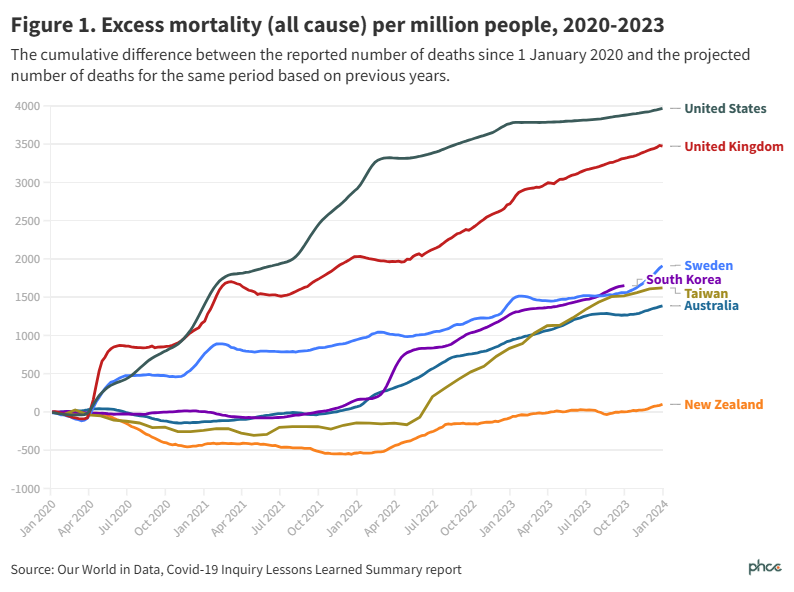
The greatest lesson from NZ’s Covid response is probably the importance of having an appropriate pandemic strategy. For the first time in history, countries successfully applied exclusion/elimination strategies to an emerging pandemic rather than the mitigation response which was the core strategy of existing pandemic plans.12 NZ joined Australia, Singapore, Taiwan and China in using this response—countries which report low and even negative excess mortality during the first two years of the pandemic (further detailed in Appendix 3).13
Indeed, both Inquiry reports endorsed the use of the elimination strategy for Covid-19. However, for this strategy to be effective, NZ will need to establish a process for rapid border closure and exclusion for pandemics above a predefined infectivity/severity threshold. This was a feature of the highly successful Taiwan response to Covid-1914 and NZ needs a similar decisive mechanism in place, while recognising that it may only be needed for the most severe pandemics.
Build and maintain infrastructure for pandemic preparedness
Delivering an effective pandemic response depends on multiple organisational structures, systems, workforce groups, and science capabilities and capacities being in place and the ability to coordinate them effectively when needed. This need is particularly strong for severe pandemics requiring an all-of-government response. NZ should consider establishing a distributed Centre for Disease Control (CDC) to strengthen its response capacity.15 Forming an Australian CDC was one of the first actions conducted by Australia following its COVID inquiry.16 A second key strategy to enhance pandemic capacity would be for NZ to actively coordinate our preparedness systems with Australia, potentially with a pandemic agreement.17 NZ is almost entirely dependent on international sources for critical pandemic supplies (eg, pandemic vaccines and PPE), so such an agreement could support greater health security.
Further planning
Effective planning will also need to acknowledge the potential for long-term health impacts, as seen with Long Covid; ensure equity in terms of who has access to vaccines and health care, and who benefits from pandemic policies; and ensure that social licence for interventions exists and that the public has a voice in decision making, through mechanisms such as citizens’ assemblies. We provide more detail on these points in the Appendix, while acknowledging that there are many more factors we have not highlighted here.
Conclusion
NZ is fortunate in having two high-quality reports that document lessons from the Covid-19 pandemic and its response and make many valuable recommendations.
The NZ Government must swiftly review and implement key recommendations from these reports to build on the good work of the commissioners, their staff and the large number of New Zealanders who contributed to these landmark documents—as indeed emphasised in the Phase 2 report (Box 1).
Box 1. Phase Two inquiry conclusion from ‘reflections’ section (p464)
The temptation after a traumatic emergency like a pandemic is to look ahead and put the experience behind us. But we urge current and future governments, and current and future citizens, not to shy away from the task of preparation. Most of what will be needed in a future pandemic needs to be developed beforehand; it is more likely to be successfully introduced if it is done in settled, normal times rather than in a rush when crisis strikes.
What this Briefing adds
- NZ is fortunate in having completed one of the highest-quality reviews of its Covid-19 response of any country with extensive Phase 1 and 2 Inquiry reports now published.
- The risk of future pandemics that are far worse than Covid-19 is substantial and these pandemics could be catastrophic (eg, from engineered pathogens).
- This threat highlights that strategy selection and border closure capacity (“keep it out”) are probably the most important parts of NZ’s pandemic planning, buying time to develop effective prevention and treatment approaches that are tailored to the specific threat. Epidemiological evidence from diverse sources confirms that NZ achieved amongst the lowest excess mortality of any country during the pandemic, providing further support for NZ’s use of an exclusion/elimination strategy for this type of severe pandemic.
- As documented in these Inquiry reports, there are lessons for delivering pandemic responses in the future that are more efficient and less disruptive to people’s lives and our economy.
Implications for policy and practice
- Given the ongoing risk of future pandemics, NZ needs to begin now on reviewing and implementing the recommendations of both Inquiry reports.
- Measures to strengthen global pandemic prevention could begin immediately by supporting WHO in implementing the revised IHR and Pandemic Agreement.
- Measures to strengthen our essential public health infrastructure could also begin immediately, given the benefits they provide for reducing the high annual burden of respiratory infections.
- Pandemic-specific preparedness measures, notably the capacity for rapid implementation of strategic responses (exclusion and elimination) will require careful consideration to ensure robust, sustainable processes are swiftly put in place.
Author details
Prof Michael Baker, Director, Public Health Communication Centre, Department of Public Health, Ōtākou Whakaihu Waka, Pōneke | University of Otago, Wellington
Assoc Prof Amanda Kvalsvig, Department of Public Health, Ōtākou Whakaihu Waka, Pōneke | University of Otago, Wellington
Dr John Kerr, Science Lead, Public Health Communication Centre, Department of Public Health, Ōtākou Whakaihu Waka, Pōneke | University of Otago, Wellington
Prof Nick Wilson, Co-Director, Public Health Communication Centre, and Department of Public Health, Ōtākou Whakaihu Waka, Pōneke | University of Otago, Wellington
Appendix 1. Inquiry findings overview
Box A1. Selected key points and extracts from the Phase 2 report summary
| Area of assessment | Positive evaluations | Critiques and areas for improvement |
| Vaccine approvals and safety | “Decisions carefully balanced the benefits of COVID-19 vaccines for the health and safety of New Zealanders, against any potential risks (all medicines have side effects).” (page 16). “Communications about risks from COVID-19 vaccines were extensive and followed established procedures.” (page 16). | “Decision-makers…did not anticipate the extent to which concerns about vaccine safety would emerge and seize attention.” (page 22). “…shortfalls in clarity and effectiveness existed in terms of what providers heard about risks and, in turn, communicated to consumers.” |
| Vaccine mandates | “The decisions on vaccine requirements reflected the advice given and paid significant attention to experience in comparable jurisdictions.” (page 17). “Vaccination requirements are a valid intervention that should be kept in the toolbox for future pandemic responses. However,… they should be used with great care.” (page 17). | “…labour market implications could have been explored further.” (page 17). “In hindsight, some vaccination requirements were introduced too slowly, some lasted too long and some went too far.” (page 17). “…it is clear that vaccination requirements had significant social and economic implications, particularly for those who declined the vaccine.” (page 17). |
| National and regional lockdowns | “…we consider [decision-makers] were sufficiently informed as to the main impacts of their decisions. Their decisions closely followed the public health advice that was given to them, and they took into account the experiences of other comparable countries in an appropriate way.” (page 19). “The approach to balancing interests was reasonable and evidence-based”. (page 19). | “However, [decision-makers] would have benefitted from additional data and information relating to the potential impacts of the choices before them.” (page 19). “[Regarding Auckland lockdowns in late 2021] A more structured approach to strategy review could have identified the change in circumstances and allowed for consideration of a different strategy sooner.” (page 19) |
Testing and tracing technologies | “The reliance on PCR testing during much of 2021 reflected expert advice and was consistent with the elimination strategy (which required highly accurate tests to support contact tracing).” (page 18) | “However, the PCR testing system came under immense strain, to the point where it was overwhelmed in early 2022. The slowness in approving alternatives and allowing firms to import tests themselves meant that, in late 2021 and 2022, some people lacked easy access to a reliable test to help them and their employers decide on actions such as self-isolation or returning to work.” (page 18) |
Elimination strategy, and transition out of it | “Overall, New Zealand’s initial response to the COVID-19 pandemic was successful. The elimination strategy achieved its goal of saving many lives. The Inquiry’s Phase One report found that while our lockdown measures were strict, New Zealand spent less time in lockdown than many other countries and experienced relatively good social and economic outcomes, at least at first.”(page 3). | “Elimination strategies can be very beneficial in terms of preventing large numbers of deaths and hospitalisations from a severe pandemic. But they are difficult to exit. Governments should present such strategies from the outset of a pandemic as temporary measures and establish mechanisms that trigger prompt, regular and transparent strategic reviews. Taking these measures is likely to build trust in government and help plan for the exit from any elimination phase.” (page 22). |
Conclusion | “This report concludes that New Zealand’s response to the COVID-19 pandemic was effective, yet also recognises areas where the Government’s response could have been strengthened. While New Zealand displayed some remarkable resilience in coming through this pandemic, we must not miss the opportunity to build resilience for the future.” (page 35) |
Appendix 2. Recommendations of note
Below are selected recommendations taken from the Phase 2 Inquiry report. For all recommendations, see the full report.
Lesson One: Systems that promote good government decision-making
Six recommendations, including:
Recommendation 1C: Present elimination strategies as temporary
Decision-makers should explicitly present elimination strategies as temporary from the outset of a pandemic, including in the New Zealand Pandemic Plan. This would help shape and manage public expectations, and create an impetus for forward planning (page 28)
Recommendation 1D: Investigate a new strategic function
The Prime Minister and Minister for the Public Service should investigate establishing a permanent strategic function, either in the Treasury or the Department of the Prime Minister and Cabinet, and set up a clear work programme for that function.
Recommendation 1E: Set aims for the new strategic function to improve modelling, estimated impacts, data and a new framework for advice
The permanent strategic function at the centre of government should work with relevant agencies to:
- ensure the capacity to stand up epidemiological modelling quickly in an emerging future pandemic
- strengthen estimates of the expected impacts of public health measures on key health, economic, social and educational outcomes
- improve the data available to decision-makers in real time to monitor actual impacts of public health measures, once they have been implemented, and
- develop a framework for structuring advice to decision-makers in a future pandemic that enables them to effectively weigh impacts of public health measures across desired outcomes, and so to identify the important trade-offs.
Recommendation 1F: Set an external trigger for regular and transparent strategic reviews
Decision-makers facing a severe pandemic should introduce an external trigger for regular and transparent strategic reviews. This could comprise:
- a statutory requirement to regularly review and report to Parliament on the adequacy of current pandemic strategic settings, and/or
- the establishment of an independent review board, which would review and report on pandemic strategies. Such a board should include expertise and perspectives from the public sector, the public health community and others outside government.
Lesson Two: Legislation: the guardrail for fundamental rights and freedoms
Five recommendations, including:
Recommendation 2A: Develop standing primary legislation for pandemics
- To create a clear and enduring legal framework for managing future pandemics, the Government should establish dedicated primary legislation.
- This framework should set out the most significant powers and tools available to government in a pandemic response, including restrictions on movement and vaccine requirements, ensuring restrictions on human rights are grounded in primary legislation.
Recommendation 2B: Ensure pandemic legislation includes clear powers, safeguards and flexibility
- The pandemic legislation should clearly define the scope and limits of emergency powers, including:
- the triggers for activating them
- the appropriate decision-making authority
- the circumstances under which exemptions from powers, penalties or offences may apply.
- The legislation should embed strong safeguards – both procedural and substantive, and both proactive and reactive. The legislation and use of powers should be subject to ongoing review and reporting, and decision-makers should be required to explicitly consider:
- human rights, and how any limitation on those rights is justified, necessary and evidence-based
- principles such as proportionality and the use of least restrictive measures (which should be set out in the legislation to guide decision-making and the use of public health tools)
- social and economic considerations, in balance with public health advice.
- The legislation should provide for flexibility, enabling the response to be scaled and adapted as circumstances change. However,
decision-makers should be required to weigh social, economic and public health considerations at every stage of the response. - The legislation should provide for periodic review, to ensure it remains fit for purpose.
Lesson Three: Agile and robust economic policy
Nine recommendations, including:
Recommendation 3A: Prepare guidance for decision-makers in a future pandemic
The ‘strategic function’ recommended in Lesson One should prepare and maintain a short-form guide for decision-makers facing a pandemic.
Lesson Four: Readiness for social impacts and post-pandemic recovery
Four recommendations, including:
Recommendation 4B: Ensure good transparency and communication of decisions in a pandemic
Governments facing a pandemic should:
- be guided by the best scientific evidence available at the time, in designing their responses and setting specific public health measures
- be open and clear about the science and evidence they are using (including its limitations), and that knowledge may change and develop over time
- be open and clear about where they are obtaining their information from, and how they have reached decisions, so others can review that material and the conclusions the government is drawing from it.
Recommendation 4C: Task an agency to monitor research and advise on policy regarding trust and social cohesion measures
The Government should task an agency with responsibility for monitoring local and international research and policy into initiatives that increase trust and social cohesion, and for advising on lessons and policy options for New Zealand.
Appendix 3. Further considerations for pandemic planning and preparedness
Exclusion/Elimination are successful strategies for severe pandemics – The greatest lesson from NZ’s Covid response is probably the importance of having an appropriate pandemic strategy. For the first time in history, countries successfully applied exclusion/elimination strategies to an emerging pandemic rather than the mitigation response, which was the core strategy of existing pandemic plans.12 NZ joined Australia, Singapore, Taiwan and China in using this response—countries which report low and even negative excess mortality during the first two years of the pandemic.13 Further analysis shows that this low mortality was sustained by NZ and Australia over five years (2020-24).18 Countries using exclusion/elimination strategies did not experience worse macroeconomic harms than other countries,13 and indeed NZ outperformed some other OECD island countries on GDP growth and unemployment (eg, especially the UK).19
Both reports endorsed the use of the elimination strategy for Covid-19. The Phase One report3 also noted the potential benefits of using an exclusion strategy in a future pandemic if the pathogen is particularly infectious and virulent. For this strategy to be effective, NZ will need to establish a process for rapid border closure and exclusion for pandemics above a predefined infectivity/severity threshold. This was a feature of the highly successful Taiwan response to Covid-1914 and NZ needs a similar decisive mechanism in place, while recognising that it may only be needed for the most severe pandemics.
Lessons from Long Covid – Any assessment of new pandemic threats must also consider their likely long-term harms, as we have seen with Long Covid. 20 Important long-term sequelae were previously well documented following infections with other emerging coronaviruses, notably SARS and MERS.21 They are a common feature with many infections22, so an assumption of longer-term harms should be embedded into pandemic risk assessment decisions. The clinical and immunity status of early survivors should be actively investigated to determine the likely pattern and severity of longer-term impacts.
Integrating pandemic measures into routine practice – Response measures for the most likely pandemic scenarios overlap with those used for seasonal respiratory infections such as influenza. These measures include surveillance, vaccination, public health and social measures (notably testing and self-isolation when ill, indoor air ventilation and filtration, and respirator mask use in enclosed indoor settings such as public transport and healthcare settings), risk communication, and coordination. NZ is currently performing poorly with these interventions, so could use the annual winter cycle of respiratory infections as a way of rehearsing and improving its pandemic response measures.23 24
Health equity – Equity is a critical consideration, particularly for pandemics where mitigation is the selected strategy or for more severe pandemics where border control and elimination has failed. The need for equity was particularly demonstrated by the high levels of ethnic inequities in access to vaccination and Covid-19 outcomes during the pandemic.25 Improving these outcomes ultimately depends on addressing the entrenched causes of these stark inequities with policy responses that should be implemented now.26
Public engagement – The Inquiry reports, particularly Phase Two, provided the public with opportunities to be heard and describe vivid examples of why public engagement is critical for building awareness and social licence for effective pandemic responses. To further explore potential pandemic responses with the NZ public, one approach is to use citizens’ assemblies (panels of randomly-selected citizens tasked to make recommendations about public policies). These have been used effectively for a range of topics in Ireland eg, this country has “held four consecutive randomly selected citizens’ assemblies” and “some of those processes produced major political outcomes through three successful referendums”.27
Citizens could also be regularly surveyed on more routine responses to endemic respiratory diseases such as seasonal influenza and endemic Covid-19. For example, should healthcare staff in high risk environments be required to wear masks (given that places like hospitals remain high risk environments for Covid-19 infections for both workers and vulnerable patients)?28