Summary
Our cars are getting bigger. Vehicle ‘supersizing’ – particularly in cities – has negative impacts on both health and climate.
Evidence that big vehicles, like utes and SUVs, are more polluting; that they are driven in more dangerous ways; and that they ‘shrink’ the street space available to groups such as children and pedestrians means that we need to monitor and control their impacts. In times of global oil shortages, it’s also worth asking how much economic sense vehicle supersizing makes.
In this Briefing, we look at the rise in the use of ‘double cab utes’ in Aotearoa New Zealand (NZ). We look at where and how these large vehicles are being used, and whether we need more regulation of their use. The NZ motor vehicle industry has opposed efforts to control their growth on the grounds that utes are ‘irreplaceable’. We argue their real-world use does not support this claim.
After a period of global downsizing following the oil shocks of the 1970s, the physical and environmental footprint of private cars is growing rapidly. The RAM 2500, one of the larger utes now sold in New Zealand, weighs more than 3 tons. The 2020 version of the Toyota Corolla, once the most popular car, weighed 1.3 tons. Larger passenger vehicles make streets more congested, more polluted, and less safe. They are more likely to be driven in dangerous ways,1, 2 and to severely injure pedestrians, children, and other car drivers.3-5
Utes and SUVs are also much more polluting: for both climate and local air quality. The growth in the number of light trucks was the second biggest global contributor to increases in climate pollution in the 2010s.6 Locally, it is estimated that the social cost of hospital admissions and premature deaths due to tail-pipe NOx (nitrogen oxides) and fine particles in New Zealand is seven times greater per km for diesel vans and utes than for petrol cars (Gerda Kuschel, personal communication).
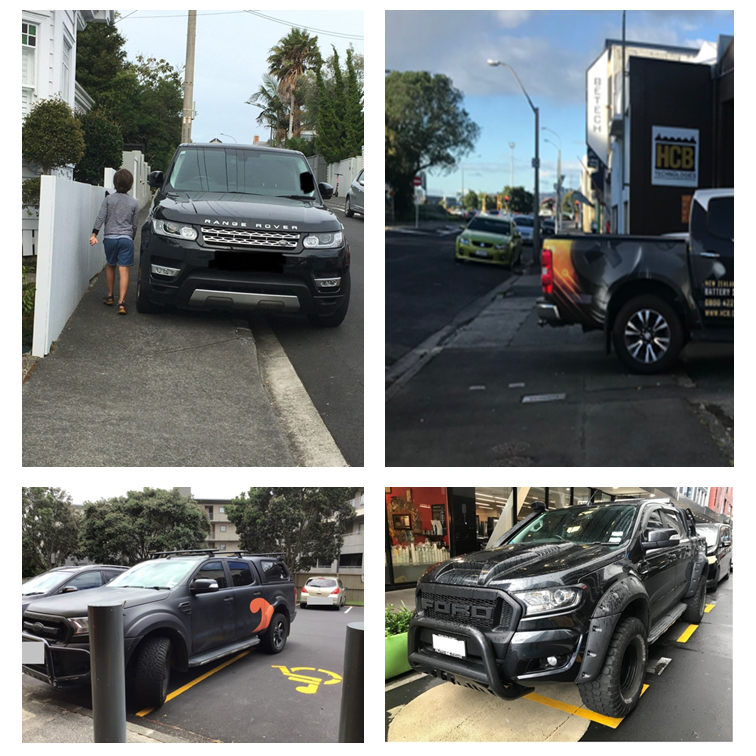
Figure 1. Examples of SUV/ute ‘overhang’ reducing the usability and safety of street spaces, Auckland and Dunedin, NZ. (Source: A. Woodward, K. Wild, and A. Macmillan)
Despite these harms, utes now dominate the list of our best-selling vehicles. Attempts to discourage their use have also been opposed in NZ by the motor vehicle industry and its supporters, on the grounds that these large vehicles perform ‘irreplaceable’ functions. For instance, the Managing Director of Ford New Zealand claimed ‘there aren’t any suitable alternatives to perform the duties that people buy [Ford] Rangers for’.7
This implies that trips made by people who buy Ford Rangers require ute-like power, size, and off-road capability. So we examined whether real-world usage supports these assertions.
Real world usage of double-cab utes in Aotearoa
In our new working paper, we examine data from the New Zealand Household Travel Survey (covering the period 2015-2020). Our aims were to identify trips made by double-cab utes and to compare the number, purpose, distance and location of drivers (urban or rural) with trips made by car or station wagon.8
Despite the marketing of these vehicles featuring rural themes,9 most ute trips (66 %) were made by drivers living in urban areas. Travel by double-cab utes was more likely to be work-related than those driving cars or station wagons, but these remained a minority of trips. A third of ute trips were for shopping, social activities, personal appointments, or drop-offs - similar to cars. Short trips predominated. A quarter of trips are less than 5 minutes for both utes and cars; and half are less than 10 minutes. Most ute trips were driver-only (88%): the rear cab was seldom used. Their use was highly gendered - the ratio of male: female drivers was more than 5:1. Overall, we found that extreme power, size and 4-Wheel Drive are not required for most trips undertaken in New Zealand by double-cab ute. For most urban trips, smaller, less polluting vehicles that do not pose such a risk to children, pedestrians, or the climate could do the job.
Vehicle supersizing is not ‘inevitable’
The oil shocks of the 1970s resulted in a significant downsizing of passenger vehicles. Downsizing is arguably even more pressing now – with more crowded cities and a heating climate. Aotearoa should pursue similar policies to those proposed and implemented elsewhere, including higher sales taxes on heavier vehicles - implemented in France and Norway;10,11 linking vehicle registration and parking charges to vehicle weight or size – implemented or proposed in a number of German, French and UK cities;12 resisting pressure to ‘supersize’ parking spaces; reducing advertising of high polluting vehicles;9-13 reforming the fringe benefit tax system that continues to encourage vehicle supersizing in Aotearoa;14 and changing the vehicle safety “star” rating to ensure that pedestrian and cyclist crash-worthiness are sufficiently recognised – not just risk to those driving a vehicle.
What this Briefing adds
- We used the Household Travel Survey to explore the real world use of ‘double-cab utes’ in Aotearoa.
- Despite marketing featuring rural, off-road themes, we found that most ute trips are short, urban trips. Travel by double-cab utes was more likely to be work-related than those driving cars or station wagons, but these remained a minority of trips. A third of ute trips, for instance, were for shopping, social activities, personal appointments or drop-offs - similar to cars.
- Real-world travel data does not support the assertion that drivers ‘need’ to use double-cab utes for most of their trips. Many of these trips could be undertaken using a smaller, safer, lower-emission vehicle.
Implications for policy and practice
To ‘right-size’ our urban vehicles, Aotearoa should pursue similar policies to those proposed and implemented elsewhere, including:
- Imposing higher sales taxes on heavier vehicles;
- Linking vehicle registration charges to emissions;
- Resisting pressure to ‘supersize’ parking spaces;
- Reducing advertising of highly polluting vehicles;
- Reforming the fringe benefit tax system that encourages vehicle supersizing in Aotearoa; and
- Changing the star vehicle safety rating to ensure that pedestrian and cyclist crash-worthiness are sufficiently recognised – not just risk to those driving a vehicle.
Authors details
Dr Kirsty Wild, Senior Research Fellow, Faculty of Medical and Health Sciences,Waipapa Taumata Rau | University of Auckland
Professor Alistair Woodward, Faculty of Medical and Health Sciences, Epidemiology & Biostatistics, Waipapa Taumata Rau | University of Auckland
Assoc Prof Caroline Shaw, Department of Public Health, Ōtākou Whakaihu Waka, Pōneke | University of Otago, Wellington
Dr Graeme Lindsay, Honorary Senior Lecturer, Epidemiology and Biostatistics, Waipapa Taumata Rau | University of Auckland