APA style

Chambers, T., Prickett, M., & Hales, S. . Denmark to dramatically reduce limit for nitrate in drinking water - should NZ do the same?. Public Health Expert Briefing. https://www.phcc.org.nz/briefing/denmark-dramatically-reduce-limit-nitrate-drinking-water-should-nz-do-same

Vancouver style

Chambers T, Prickett M, Hales S. Denmark to dramatically reduce limit for nitrate in drinking water - should NZ do the same?. Public Health Expert Briefing. . https://www.phcc.org.nz/briefing/denmark-dramatically-reduce-limit-nitrate-drinking-water-should-nz-do-same

Summary

New evidence linking nitrate contamination of drinking water to colorectal cancer has prompted the Danish Government to commit to a substantially lower drinking water limit for nitrate, reducing the allowable concentration by almost ten-fold. The new limit of 1.3 mg/L nitrate-nitrogen is based on an independent international expert assessment that concluded existing evidence indicates an increased risk of colorectal cancer at concentrations well below current guideline values (11.3 mg/L).

This development is highly relevant for Aotearoa New Zealand (NZ), where nitrate contamination of groundwater is widespread and increasing in many regions. Given the growing body of epidemiological evidence and the slow pace of international guideline reviews, NZ agencies should consider whether a dedicated reassessment of the current limit is warranted and whether existing regulatory frameworks are adequate to protect drinking water sources from nitrate contamination.

What are the health risks associated with nitrate in drinking water?

The current NZ drinking water limit for nitrate is 11.3 mg/L (as nitrate-nitrogen, equivalent to 50 mg/L as nitrate). The World Health Organization (WHO) established this limit in 1958, and retained it after reviews conducted in 2003 and 2016.1 More recently, studies have found elevated colorectal cancer risk at nitrate concentrations below this limit,2 including a national study in Denmark.3 In response, at least four countries have initiated reviews of health risks associated with nitrate,4-7 including the most thorough completed assessment in Denmark.7

What were the results of the Danish process? 

The Danish Ministry of Environment and Gender Equality has requested a series of reports since 2019 on whether the current nitrate limit sufficiently protects public health. A 2024 report concluded that, although uncertainties persist, the epidemiological evidence for colorectal cancer indicates that nitrate in drinking water poses a health risk. In 2025, an international expert group was tasked with deriving a new limit and recommended 1.3 mg/L. Following the 2026 General Election, the coalition agreement included a commitment to implement this advice with immediate effect alongside further restrictions on nitrate-sensitive drinking water areas.

Why does this matter in NZ?

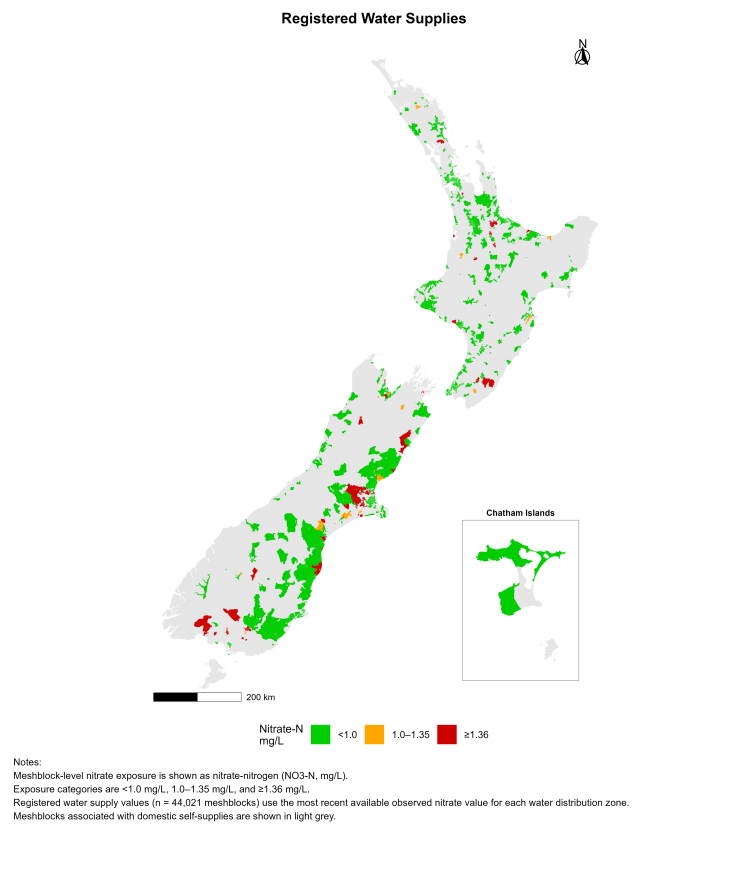
Nitrate levels in freshwater are increasing in many areas of NZ. For example, Environment Canterbury’s 2025 Annual Groundwater Quality Survey found 10% of wells exceeded the current limit for drinking water (11.3mg/L), with 62% of long-term sites showing increasing nitrate trends, leading to the council declaring a nitrate emergency in 2025.8 Recent exceedances in public supplies in Waimate and Gore have forced short-term “do not drink” responses and long-term acceptance of elevated nitrate levels.9,10 People relying on their own drinking water supplies, defined as domestic self-supplies, are particularly vulnerable as they often rely on shallow groundwater sources that are susceptible to nitrate contamination.11 Figure 1 shows the measured nitrate levels in public registered supplies (data up to 2024), that exceed the Danish limit of 1.3 mg/L.

Figure 1: Measured nitrate levels in public registered supplies (data up to 2024).

Measured nitrate levels in public registered supplies (data up to 2024), that exceed the Danish limit of 1.3 mg/L.

What can be done about it?

Taumata Arowai and Ministry of Health: Review of the current limit

NZ currently aligns most of its drinking water standards with WHO guideline values. However, the WHO reviews specific water-quality parameters only intermittently. For example, nitrate was last reviewed in 2016,12 following an earlier review in 2003.13 It seems unlikely nitrate will be prioritised in an upcoming review. Government actions could therefore include: 1) petition the WHO to prioritise the review the nitrate guideline value; 2) commissioning a bespoke assessment of the nitrate limit in the NZ context. The Ministry of Health is currently undertaking a technical review of nitrate risks for human health, due to be completed at the end of this year.14 However, it is unclear what this involves.

Taumata Arowai: Clarify roles, responsibilities and systems of accountability

Additionally, Taumata Arowai needs to formally clarify responsibilities regarding drinking water source protection between itself and regional councils. A lack of explicit delineation of roles is leading to different interpretations of existing laws and gaps in responsibility and accountability.9 It is also delaying the actions needed to reduce pollution of drinking water and forcing additional costs and complexity of treating drinking water onto drinking water suppliers, such as district and city councils.9

Central government: Rewrite Resource Management Act reforms to give strong protection for drinking water sources

There is a high risk that the Government’s proposed replacements to the Resource Management Act will establish little to no protection from nitrate contamination for drinking water sources. This is outlined in full in this previous Briefing.15 However, reforms are still under consideration through a select committee process.

Regional Councils: Evaluate existing plans efficacy for protecting drinking water sources, review data collection and identify gaps, commission independent review of conflict-of-interest management with regards to decisions on drinking water.

In many areas, regional plans have failed to protect drinking water sources from nitrate contamination.9,10,15 We previously covered three key areas in this previous Briefing that regional councils could prioritise regardless of the changing regulatory environment.16 These included: commissioning an independent evaluation of drinking water source protectionsa complementary review of data availability, suitability and collection; and a review of conflict-of-interest processes.
 

What is new in this Briefing?

  • Reports on Denmark’s decision to lower its drinking water nitrate limit from the current international standard of 11.3 mg/L to 1.3 mg/L nitrate-nitrogen following advice from an independent international expert panel.
  • Summarises the scientific rationale underpinning the Danish decision, including evidence linking nitrate exposure in drinking water to colorectal cancer.
  • Identifies policy and regulatory implications for NZ, including opportunities to review drinking water standards, strengthen source water protection and clarify institutional responsibilities.

Implications for policy and practice

  • The Danish decision signals a major shift in international thinking about nitrate in drinking water and highlights the need for NZ authorities to assess whether current standards remain sufficiently protective of public health.
  • Taumata Arowai and the Ministry of Health should consider commissioning an independent review of the nitrate limit, including assessment of emerging evidence on colorectal cancer and other linked health outcomes.
  • NZ should actively engage with the World Health Organization review process and advocate for timely reassessment of nitrate guideline values.
  • Clarifying responsibilities for source water protection and strengthening accountability across central government, Taumata Arowai and regional councils, would help reduce future public health risks.

Authors' details

Associate Professor Tim Chambers, Ngāi Tahu Research Centre, Te Whare Wānanga o Waitaha | University of Canterbury

Marnie Prickett, Research Fellow, Department of Public Health, Ōtākou Whakaihu Waka, Pōneke | University of Otago, Wellington

Professor Simon Hales, Department of Public Health, Ōtākou Whakaihu Waka, Pōneke | University of Otago, Wellington

Creative commons

Public Health Expert Briefing (ISSN 2816-1203)

References

  1. New Zealand Parliament. Water Services (Drinking Water Standards for New Zealand) Regulations 2022. Wellington (NZL); 2022. Available from: https://www.legislation.govt.nz/regulation/public/2022/0168/latest/whole.html Accessed 4 Nov 2022.
  2. Elwood JM, Werf Bvd. Nitrates in drinking water and cancers of the colon and rectum: a meta-analysis of epidemiological studies. Cancer Epidemiology. 2022;78:102148. https://doi.org/10.1016/j.canep.2022.102148
  3. Schullehner J, Hansen B, Thygesen M, Pedersen CB, Sigsgaard T. Nitrate in drinking water and colorectal cancer risk: A nationwide population-based cohort study. Int J Cancer. 2018;143(1):73-9. https://doi.org/10.1002/ijc.31306
  4. United States Environmental Protection Agency. Protocol for the Nitrate and Nitrite IRIS Assessment (Oral) (Preliminary Assessment Materials). Washington DC (USA): United States Environmental Protection Agency; 2023. Available from: https://www.regulations.gov/document/EPA-HQ-ORD-2017-0496-0010
  5.  Office of the Prime Minister's Chief Science Advisor. Nitrates in drinking-water. Wellington (NZL): Office of the Prime Minister's Chief Science Advisor; 2022. Available from: https://www.pmcsa.ac.nz/topics/nitrates/
  6. ANSES. Opinion of the French Agency for Food, Environmental and Occupational Health & Safety on the risks associated with the consumption of nitrites and nitrates. Paris (FRA): ANSES; 2022. Available from: https://www.anses.fr/en/system/files/ERCA2020SA0106EN.pdf
  7. Ministry of Environment and Gender Equality of Denmark. Evaluation of the parametric value for Nitrate in drinking water. Copenhagen (Den): Ministry of Environment and Gender Equality of Denmark; 2026. Available from: https://mim.dk/media/1qwjukfe/evaluation-of-the-parametric-value-for-nitrate-in-drinking-water.pdf
  8. Environment Canterbury. Annual Groundwater Quality Survey 2024. Christchurch (NZL): Environment Canterbury; 2025. Available from: https://www.ecan.govt.nz/document/download?uri=5589082
  9. Prickett M, Chambers T, Hales S. When the first barrier fails: public health and policy implications of nitrate contamination of a municipal drinking water source in Aotearoa New Zealand. Australasian Journal of Water Resources. 2023:1-10. https://doi.org/10.1080/13241583.2023.2272324
  10. Gore District Council. Water Notice. Online: Gore District Council; 2025. Available from: http://goredc.govt.nz/services/3-waters/water-notice
  11. Rogers KM, Bradshaw D, Scadden P, Tschritter C, Sanderson S, Cooper J, et al. Nitrate contamination in New Zealand's domestic drinking water with a focus on rural groundwater-sourced self-supplies. Science of The Total Environment. 2025;1002:180549. https://doi.org/10.1016/j.scitotenv.2025.180549
  12. World Health Organization. Nitrate and Nitrite in Drinking-water. Geneva (CHE): World Health Organization; 2016. Available from: https://cdn.who.int/media/docs/default-source/wash-documents/wash-chemicals/nitrate-nitrite-background-jan17.pdf?sfvrsn=1c1e1502_4
  13. World Health Organization. Nitrate and nitrite in Drinking-water. Geneva (CHE): World Health Organization; 2003. Available from: https://cdn.who.int/media/docs/default-source/wash-documents/wash-chemicals/who-sde-wsh-04-03-56-eng.pdf?sfvrsn=e2fe0837_4
  14. MacDuff, K. Health Ministry launches review into effects of nitrate in water. RNZ, Wellington NZ. 12 June 2026. Available from: https://www.rnz.co.nz/news/health/598065/health-ministry-launches-review-into-effects-of-nitrate-in-water
  15. Prickett M, Doole M, Hales S. Our drinking water sources have close to no protection in RMA replacement. Wellington (NZL): Public Health Communication Centre; 2026. Available from: https://www.phcc.org.nz/briefing/our-drinking-water-sources-have-close-no-protection-rma-replacement
  16. Prickett M, Canning A, Chambers T, Baker M, Hales S. Regulator failure on nitrate in drinking water dumps escalating costs on those downstream. Wellington (NZL): Public Health Expert Briefing; 2024. Available from: https://www.phcc.org.nz/briefing/regulator-failure-nitrate-drinking-water-dumps-escalating-costs-those-downstream
  17. Chambers T, Prickett M, Hales S. ECan’s ‘Nitrate Emergency’: Good step but here is a more robust path for region’s drinking water. Wellington (NZL): Public Health Communication Centre; 2025. Available from: https://www.phcc.org.nz/briefing/ecans-nitrate-emergency-good-step-here-more-robust-path-regions-drinking-water

About the Briefing

Public health expert commentary and analysis on the challenges facing Aotearoa New Zealand and evidence-based solutions.

Subscribe

Briefing CTA

Public Health Expert Briefing

Get the latest insights from the public health research community delivered straight to your inbox for free. Subscribe to stay up to date with the latest research, analysis and commentary from the Public Health Expert Briefing.