Summary
The Climate Change Commission has just published Aotearoa New Zealand’s (NZ) second National Climate Change Risk Assessment (NCCRA). This important report uses expert judgement to identify and describe current and future-potential risks of climate change in NZ, including interactions between risks and the readiness of current policies to address them. The NCCRA assessed climate related impacts on mental health as already a major public health risk (eg, from anxiety around extreme weather events) and risks to physical health as moderate. Both risks have potential to become extreme by the 2090s under current policies, which were described as “uncertain and incomplete”.
The report recognises the interdependence of adaptation and mitigation policies, and the indirect health risks resulting from climate impacts in other domains, such as water infrastructure. Quantitative assessment of direct and indirect health risks has not yet been completed, which is a major gap that needs to be addressed. Climate policies now need to be updated across all sectors, especially where there are health co-benefits.
This month the Climate Change Commission, an independent Crown entity, published NZ’s second National Climate Change Risk Assessment (NCCRA).1 This builds on the first assessment published in 2020.2 This update matters because it is a statutory instrument required under NZ’s Climate Change Response Act 2002.3
The NCCRA provides a national scale assessment across seven interconnected domains based on NZ and international qualitative and quantitative evidence. That is a major task, given the complexity of climate change risks, their potential nonlinearities and interactions, and the uncertainties of extrapolating historical evidence to an uncertain future. Risks were assessed for current conditions and projected for the 2050s and for 2090s.
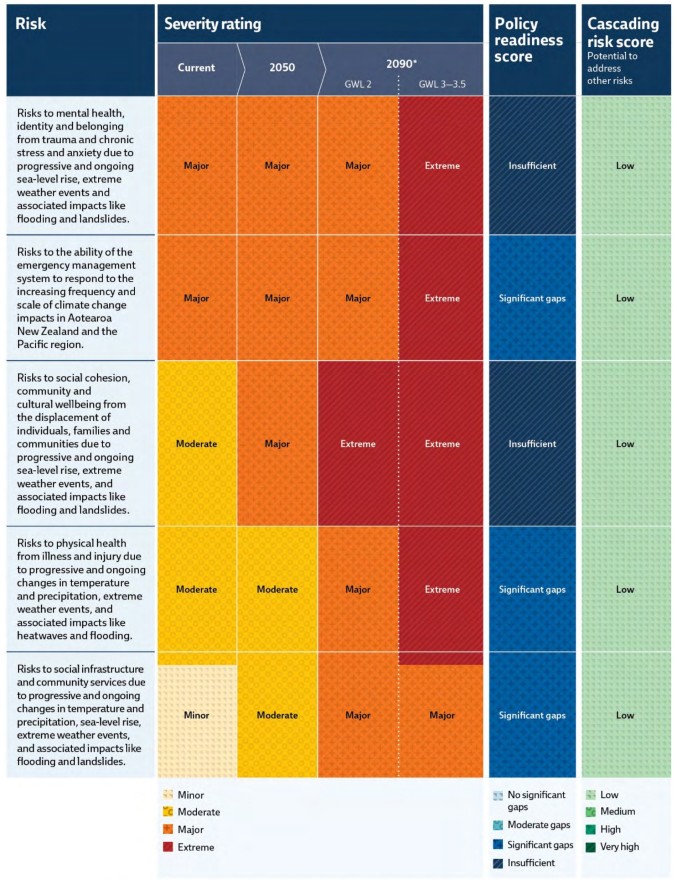
Risks are categorised under domains. All identified risks have implications for public health, most directly those included in the domain “People, health and communities”. Under this domain, poor mental health because of climate change is identified as a major risk today, becoming “extreme” in the 2090s if global average temperatures increase to 3 degrees or more (Table 1). An example of this mental health impact is the stress and anxiety generated by extreme weather events damaging homes and infrastructure. Risks to physical health are “moderate”, rising to “major” in 2090s at 2 degrees, and “extreme” at 3 degrees.
However, all domains include risks strongly related to public health, including issues regularly covered in Public Health Communication Centre Briefings such as governance relating to climate change, water infrastructure, disproportionate impacts on Māori health, energy, housing, environmental health, and food security.
Table 1: Results for People, Health and Communities domain from the NCCRA.
*GWL 2 assumes an increase in global average temperature of 2⁰C; GWL 3-3.5 assumes an increase in global average temperature of 3-3.5⁰C.1 See appendix and 'Summary of method for the 2026 National Climate Change Risk Assessment for Aotearoa New Zealand'5 for definitions.
Assessment of policy readiness identifies major gaps
Policy readiness for individual risks refers to the degree to which existing and planned adaptation actions will contribute to addressing the risk. The NCCRA concludes that policy to address these risks is “uncertain and incomplete” (p209).1 Policy readiness is described as either “insufficient” (the lowest category) or having “significant gaps” (Table 1). Risks to public health are recognised, but responses lack funding and coordination. The Health National Adaptation Plan (HNAP)5 is the main policy strategy for climate and health, but its effectiveness “…remains uncertain due to actions remaining unfunded and the absence of a detailed delivery plan.”1
The NCCRA notes, correctly, that some policies intended to mitigate climate change can have important health co-benefits (eg, walking and cycling infrastructure generate health benefits via physical activity). However, the current Government has, unfortunately, removed or undermined many of these (described in previous Briefings). That issue is not specifically mentioned, but NCCRA authors note, “…many of the adaptation actions that would have flow-on benefits for physical health are actions relating to other areas such as infrastructure and transport policy that sit outside the health sector” (p209).1
Gaps in evidence that need to be addressed
Evidence of direct impacts of climate extremes on human health is relatively strong.6 For more indirect impacts, such as on mental health, nutrition or infectious diseases, there are many gaps in quantitative evidence. Nevertheless, given the high likelihood of widespread harms to public health from climate change, this limitation should not delay adoption of adaptation and mitigation policies.
It is technically possible to estimate health impacts of climate change quantitatively, and at local scale, based on weather and climate observations and historical records of health outcomes. This has been done by national and international studies for a subset of health risks.7 Of 12 knowledge and risk assessment focus areas in the HNAP, only one has yet received specific funding: a national climate change and health vulnerability and adaptation assessment.4,8
The new assessment, not yet completed, will quantify specific health risks, with geographic and demographic detail on where vulnerable communities live, who is affected, and how existing health inequalities may be worsened, unless policies prevent this.4,8 Ideally, a vulnerability and adaptation assessment is the first task in developing a HNAP, but the process of responding to climate change is necessarily iterative, and given the urgency of responding to climate change, progress needs to be made in parallel research streams.
Box 1: Adaptation vs mitigation
Adaptation and mitigation are both critical to our national climate change response, and they are different yet interdependent.9 Without mitigation, adaptation is increasingly difficult and costly. Coherent adaptation efforts will contribute to mitigation, but poor adaptation can increase emissions.10
Adaptation means, “The process of adjusting to the actual or expected changes brought about by climate change. For people, and the systems people create, this means making changes to try to avoid or minimise the harm or damage from climate change and its effects – or to benefit from opportunities climate change might provide. These could be changes, for example, to laws, policies, practices, processes, as well as to physical structures and the built environment. In nature, and within natural systems, adaptation can happen by itself through ecological and evolutionary processes, or with human assistance, by helping those systems adjust to climate change and its effects”.1 Of note is that wise adaptation to climate change can improve resilience from other hazards eg, well-insulated houses provide benefits from both heatwaves and cold winters.
Mitigation means, “Human actions to reduce emissions by sources or enhance removals by sinks of greenhouse gases. Examples of reducing emissions by sources include walking instead of driving or replacing a coal boiler with a renewable electric powered one. Examples of enhancing removals by sinks include growing new trees to absorb carbon, or industrial carbon capture and storage activities”.1 Some of the co-benefits of mitigation for public health include those arising from physical activity (walking and cycling for active transport), from reduced air pollution (if renewables replace fossil fuel burning), and for cardiovascular health (from plant foods replacing animal products which are high in saturated fats). At a national level, mitigation via a shift to renewable energy, increases national energy security by reducing NZ’s extreme dependence on imported liquid fuels with volatile prices (100% of diesel, petrol and jet fuel are imported).
What this Briefing adds
- The NCCRA report reinforces that NZ’s climate change and health policy is insufficient, with many gaps in knowledge, funding, and coordination.
- Climate change impacts on public health are relevant across all domains covered by the NCCRA. Quantitative gaps in evidence for risk assessment remain to be addressed.
- The NCCRA assessed climate related impacts on mental health as already a major public health risk (eg, from anxiety around extreme weather events) and risks to physical health as moderate.
Implications for policy and practice
- It is imperative that the NZ Government, and all decision- and policy-makers, recognise that reducing emissions and adapting to climate change are interdependent. Mitigation requires more urgent and effective policy, in NZ and internationally, if major or extreme risks are to be avoided in the second half of this century.
- Resourcing and coordination of climate change policies need to be strengthened across all sectors, with input from public health experts and with a focus on health co-benefits.
- Improving and protecting public health must be a priority consideration with all climate change policies.
Authors details
Professor Simon Hales, Co-Director, Public Health Communication Centre, and Department of Public Health, Ōtākou Whakaihu Waka, Pōneke | University of Otago, Wellington
Marnie Prickett, Science Lead, Public Health Communication Centre
Prof Michael Baker, Director, Public Health Communication Centre, and Department of Public Health, Ōtākou Whakaihu Waka, Pōneke | University of Otago, Wellington