Summary
Recent fatalities have highlighted dog-related injuries as a serious issue in Aotearoa New Zealand (NZ). The number of injuries has been increasing over time, including more than 29,000 Accident Compensation Corporation (ACC) claims and more than 1000 hospitalisations in the last year.
Specific amendments to the Dog Control Act 1996 are urgently required to reduce these injuries, including: Mandatory sterilisation of dogs; Mandatory notification of dog-related injuries by health professionals and veterinarians; and statutory empowerment of Animal Management officers to promptly respond to high-risk situations.
Sustained equitable resourcing of animal management to support these strategies is also critical. These evidence-based and feasible approaches have been informed by a multi-sectoral group of key stakeholders and have been shown to be socially acceptable to communities.
Dog-related injuries are an issue of both human and animal welfare, with prevention efforts requiring a careful and considered public health, evidence-based approach, focusing on systems and organisational-level change. Specific amendments to the Dog Control Act are required now.
The problem
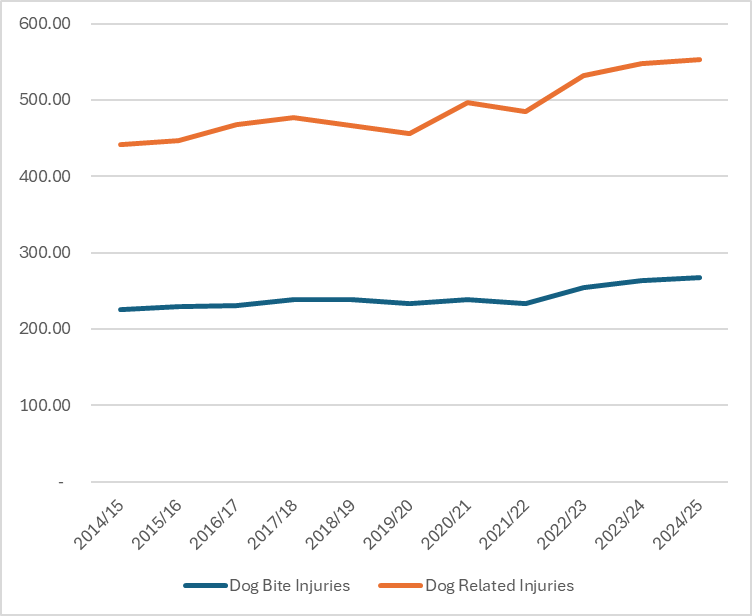
Research has demonstrated the breadth and seriousness of this issue in NZ, with NZ’s ACC (the country’s no-fault insurance agency) statistics recording 29,220 ACC claims for dog-related injuries in 2024/25, with 1139 hospitalisations.1 Nearly half (n=14,120) of these claims are from dog-bite injuries, with the remainder being injuries such as head-trauma, fractures or scratches, which can be severe. Bite injuries occur more often on limbs in adults, but in children, due to their size relative to the dog, more commonly on the face/head/neck region.2 Rates of injury have been increasing steadily over time, with consistently high annual rates within each region across NZ.1,2 Rates are higher in low-socioeconomic regions and among Māori, reflecting broader historical and ongoing structural inequities and underinvestment. Rising injury rates and recent fatalities demonstrate a clear need for action.
Figure 1: National incidence of dog-related and dog-bite injury ACC-Claims (per 100,000 people)
A study on caregiver perspectives demonstrated that dogs are highly valued by many within NZ, often seen as part of the family.3 However, dogs can also cause significant physical or emotional harm to children in both public and private places, with over-trust in dogs a key feature in incidents.3 Dogs also can mean children aren't able to walk to school independently.3 Dog attacks can impact guide dogs 4 other dogs,5 pets,6 livestock,7 and wildlife.8 The threat of dog attacks also limits the ability to walk within local streets, parks and beaches,3 and may deter tourist activities such as cycle-touring and trail walking. This is also an animal welfare issue with large numbers euthanised annually when they are not collected from a shelter (>6000 in Auckland in 2024/25).9
Evidence for solutions
A systematic review of the international evidence for prevention of dog-bite injuries reveals that dog control legislation, particularly when focused on population control, is the most effective strategy to reduce injuries.10 Dog control strategies employed in these studies included sterilisation, euthanasia, stray-dog management, infringements for attacks or roaming dogs, leash-laws, dog-registrations, or owner-licensing. These had more impact than interventions focused on dog welfare alone. A further effective strategy in one country was the introduction of mandatory notification of dog-related injuries by veterinarians and health professionals, which decreased insurance claims for dog-bite injuries by nearly a third.11,12
A study of NZ dog control strategies revealed that regional differences in injury rates cannot be explained by differences in the registered dog population.13 The study highlighted current legislative issues, including: high numbers of unregistered dogs; lack of sterilisation and breeding regulation; the inability of animal-management officers to promptly intervene following attacks, and to set fencing requirements or infringements for attacks on people or roaming dogs; a protracted prosecution process with few undertaken; a lack of legislation protecting children; a lack of notification by health professionals and veterinarians; and inequitable resourcing.12,13 At an individual and policy level, the high value people place on dogs may be a barrier to introducing these injury-prevention strategies.3
Recommendations
Evidence-based, feasible and socially acceptable recommendations were developed by researchers and Safekids Aotearoa as national experts on child injury-prevention. This was done through engagement with the community and a multi-sectoral dog-bite prevention group over six years, including annual hui and two surveys. Equity and the protection of children remain paramount and beyond reproach when considering these strategies.
Primary prevention of dog-related injuries
Primary prevention through dog population control is required, with recommendations that at least 83% of female dogs are sterilised.14 Recent Animal Management reports demonstrate that current sterilisation rates in NZ are low, with Auckland having only 65% of the 131,123 known dogs desexed, and lower rates (12%) in dogs impounded for roaming or attacks.9 Current reliance on low-cost sterilisation programmes or solely sterilising dogs released from shelters are ineffective approaches due to being a ‘drop in the bucket’, with only 1-2% of dogs sterilised per year.9 South Australia introduced mandatory dog sterilisation and breeder registration in 2018, with a requirement for sterilisation to be completed by six months of age or within 28 days of an owner taking possession of the animal, except where the dog is owned by a registered breeder or exempt on veterinary grounds. The exemption allows for professional decisions to maintain ethical standards for individual dog welfare. To create an unambiguous social norm across all regions NZ requires equivalent legislation,15 with existing low-cost sterilisation programmes providing support for low-income families.
Further local bylaws regarding environmental safety modifications should be implemented and enforced for all dogs, including leash use, for which there is strong advocacy from caregivers,3 and limits on the number of dogs kept on a property. An amendment to the Dog Control Act 1996 is required to allow local bylaws for minimum fencing requirements. 13
Secondary prevention of dog-related injuries
Secondary prevention following incidents of attacks or roaming is required through adequate identification of dogs causing harm, with provision of education and support and enforcement of safety standards.13
Improving identification of high-risk situations requires a multi-sectoral approach. One study showed that <1% of patients with dog-related injuries presenting to a public hospital had any documentation of notification to Animal Management.12 This leaves victims responsible for reporting, which can be difficult, as the incident has often occurred within their community and they may fear repercussions to themselves, the owner or the dog. Family involved in a recent incident also raised concerns about the lack of formal reporting by healthcare staff following prior attacks by the same dogs, that later went on to cause a fatal attack.16 Mandatory notification of dog-related injuries by health professionals and veterinarians must be introduced, and increases notification of the most relevant cases, even without full compliance.17 A system for notification is operational in Auckland via Starship Guidelines, serving as a model for other regions, with a call for community leadership “Ko te tohu o te rangatira he manaaki” (the symbol of leadership is the duty of care and responsibility), and kotahitanga (collective responsibility).18
Specific amendments to the Dog Control Act 1996 are also urgently required to empower Animal Management to respond promptly and proportionately to attacks.13 This includes the capability to immediately seize dogs in specified circumstances such as following an attack; if multiple dogs are kept on a property; if dogs are not compliant with sterilisation or registration requirements; or where there are child-safety concerns. They also require a limit placed on the number of disputes or appeals by owners; establishing a single ‘high-risk’ category for dangerous and menacing dogs; and the ability to set and issue infringements for roaming dogs or attacks on people, particularly children.
Resourcing and Equity
Resourcing is currently inequitable, with some regions in NZ having only 1-2 Animal Management officers covering large geographical areas and populations.13 Additional sustained investment is required, with a focus on sterilisation and enforcement. Partnership with Māori and iwi-led initiatives will ensure prevention approaches are locally led, culturally responsive, and equitable.
What this Briefing adds
- Dog-related injuries are increasing, with 2024/25 statistics of 29,220 ACC claims, 1139 hospitalisations, and recent fatalities highlighting this as a serious issue.
- Evidence from a systematic review and analysis of dog-related injury rates relative to regional policy, supports the need for statutory change to both central and local dog control legislation.
- Successful implementation of these strategies will also require an increase in resourcing and equitable distribution, with accessible low-cost sterilisation.
- Partnership with Māori and iwi-led initiatives will ensure prevention approaches are locally led, culturally responsive, and equitable.
Implications for policy and practice
Specific amendments to the Dog Control Act are urgently required to adequately protect the public and children, including:
- Mandatory sterilisation of all dogs, to be completed by six months of age or within 28 days of an owner taking possession of the animal, except where the dog is owned by a registered breeder or exempt on veterinary grounds.
- Mandatory notification of all dog-related injuries by health professionals and veterinarians to Animal Management.
- Enhanced powers for local councils and Animal Management officers to:
- Immediately seize dogs in specified circumstances, including following an attack; if multiple dogs are kept on a property; if dogs are not compliant with sterilisation or registration requirements; or where there are child-safety concerns.
- Set minimum fencing standard.
- Limit the number of disputes or appeals by owners to one.
- Establish a single ‘high-risk’ classification for dangerous and menacing dogs.
- Set and issue infringements for roaming dogs or attacks on people, particularly children.
Authors details
Dr Natasha Duncan-Sutherland, Emergency Specialist, Adult Emergency Department, Te Toka Tumai, Auckland.
Mareta Hunt, Director, Safekids Aotearoa. Tūhoe, Ngāti Awa, Ngāti Maniapoto, Rereahu, Ngāti Kahungunu me Kai Tahu.
Professor Bridget Kool, Epidemiology & Biostatistics, Faculty of Medical and Health Sciences, Waipapa Taumata Rau | University of Auckland
Dr Michael Shepherd, Paediatric Emergency Specialist, Te Toka Tumai, Auckland.
Competing Interests Nil. Research was conducted with funding from the Starship Foundation.