Summary
This Briefing presents the key findings from the 2025 National Skin Cancer Survey in Aotearoa New Zealand funded by Health New Zealand. It highlights the high rates of sunburn (64% at least once last summer), especially among young adults, and identifies gaps in sun protection behaviours, knowledge, and attitudes.
The survey reveals that while most New Zealanders are aware of skin cancer risks, many do not consistently practice effective sun protection. There are also widespread misconceptions about sun safety, and a significant portion of the population holds positive attitudes toward tanning (50% like to get a suntan). Despite these challenges, there is strong public support (82% to 90% support or strongly support) for government investment in skin cancer prevention, including education campaigns, improved policies in schools and workplaces and greater access to sun protection resources.
Skin cancer is a major public health challenge in Aotearoa New Zealand (NZ), with nearly 100,000 diagnoses annually and an economic burden approaching $495 million per year.1 Although skin cancer is highly preventable, with over 90% of cases linked to excessive ultraviolet radiation (UVR) exposure, recent survey data reveal persistent gaps in knowledge, attitudes, and behaviours related to sun protection. The 2025 national survey, conducted by the Te Rōpū Rangahau ō Te Kāhui Matepukupuku (Cancer Society – University of Otago Research Collaboration), provides the most comprehensive and up-to-date snapshot of New Zealanders’ sun protection practices, risk perceptions, and support for skin cancer prevention initiatives.2
Survey overview
The survey sampled 2,198 adults aged 18 and over. Quota sampling and post-stratification weights ensured representation of the total population by age, gender, and ethnicity. The survey explored sun exposure, sunburn incidence, intentional tanning, sun protection behaviours, sun protection product ownership (e.g., sun protective hat), knowledge, attitudes, and support for government investment. Percentages below have been weighted to reflect the Census population in terms of age, gender, and ethnicity.
Key findings
Sun exposure and sunburn
- Time outdoors: 82% of adults spent more than 15 minutes outdoors between 10am and 4pm at some point in the previous week. This rose to over 90% among 18–24-year-olds.
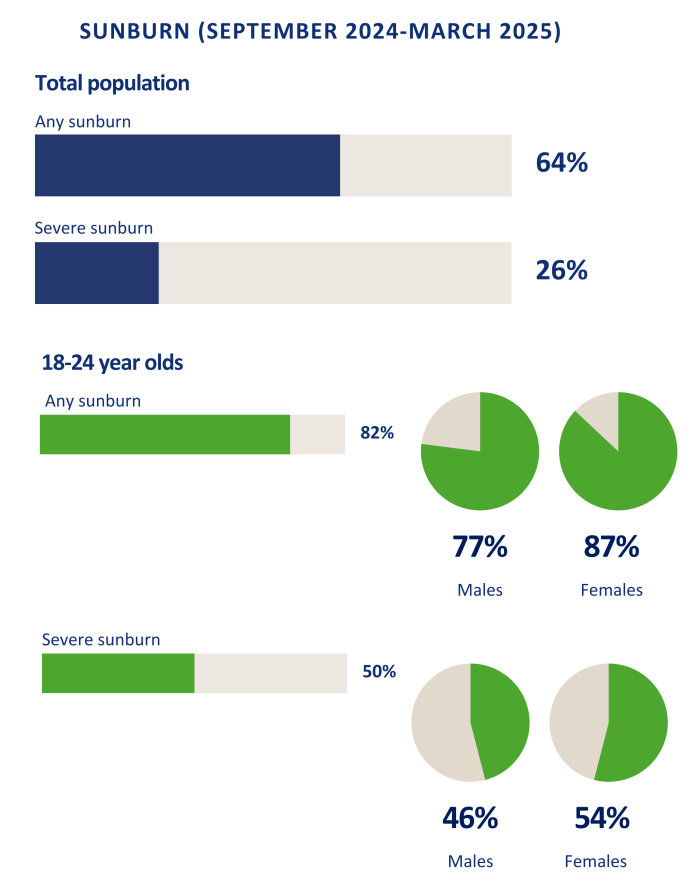
- Sunburn prevalence: Nearly two-thirds (64%) of respondents reported at least one sunburn during the 2024–25 summer and 26% reported a severe sunburn (pain for two or more days or blistering) (Figure 1). Rates were highest among young adults (aged 18–24) with 87% of females and 77% of males in this age group reporting sunburn, and 54% of females and 46% of males in this age group reporting severe sunburn.
Figure 1: Sunburn reported by New Zealanders 2024/2025 summer
- Multiple sunburns: Over one-third of 18–24-year-olds reported more than three sunburns in the summer.
Sun protection behaviours
- Protective actions: Only 38% reported “always” or “often” protecting all exposed skin during summer. Sunglasses (59%), shade (48%), and sunscreen (48%) were the most common protective measures.
- Gaps in protection: 40% of adults do not own a sun-protective hat. Bucket hats (with less side and neck protection) are more common among young adults, while broad-brimmed hats are more common among older adults and females.
- Barriers: The most common reasons for not using sunscreen were perceived lack of need, inconvenience, lack of availability, or forgetfulness. Only 38% of sunscreen users applied it at the recommended 20 minutes before going outside.
Knowledge and attitudes
- Knowledge gaps: Only 4% correctly identified the UV index at which sun protection is recommended (i.e., level 3).
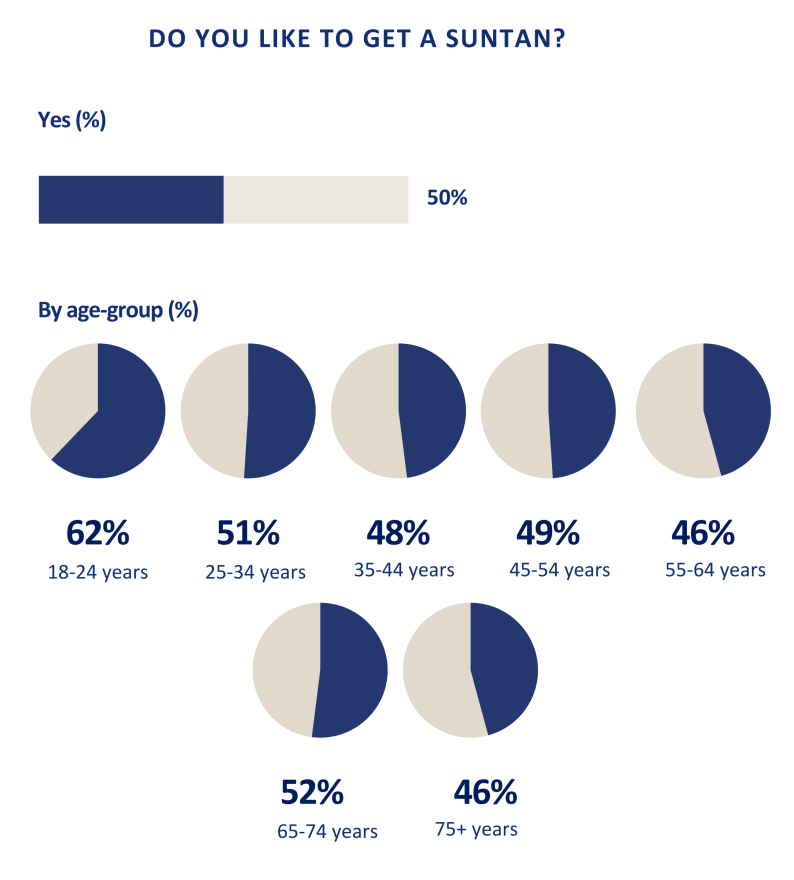
- Attitudes toward tanning: 43% agreed that a tanned person looks healthier, and 50% reported liking to get a suntan (Figure 2). These attitudes were most prevalent among 18–24-year-olds.
Figure 2: Attitude to a suntan
- Myths: Nearly one-quarter (23%) believed a suntan protects against melanoma and other skin cancers. About one-third (36%) believed sunscreen with a SPF50 rating does not need to be reapplied as often as SPF30, and a similar proportion believed a cap provides adequate protection.
Support for prevention and policy
- Strong public support: Over 86% of respondents supported each of the following initiatives: comprehensive SunSmart programmes, SunSmart campaigns, and increased shade in public spaces and schools. For each initiative, fewer than 3% of respondents expressed opposition.
- Workplace and school policies: Only 49% of outdoor workers reported a workplace sun protection policy, and just over half (54%) said their employer provided sun protection products. Parents were more confident in primary schools’ sun protection (73%) than secondary schools (58%).
Conclusion
Despite high awareness of skin cancer risk, New Zealanders’ sun protection behaviours remain inconsistent, and sunburn rates are high, particularly among young adults. There is overwhelming public support for government action. A coordinated, well-funded, and evidence-based approach is essential to reduce the burden of skin cancer and protect future generations.
What this Briefing adds
- Sunburn continues to affect a large proportion of New Zealanders, particularly young adults, and intentional tanning remains common, especially among young women.
- There are ongoing gaps in sun protection behaviours and attitudes, reinforcing the need for stronger education, improved policies, and better access to sun safety resources.
- Public support for government investment in skin cancer prevention remains extremely strong, providing a clear mandate for action.
Implications for Policy and Practice
- There is an urgent need for renewed investment and action in skin cancer prevention. Key recommendations include:
Strengthen public education: Address knowledge gaps and persistent myths, especially among young adults, through targeted campaigns such as the one occurring this summer.
Support behaviour change: Develop interventions that address social norms and appearance-related motivations, particularly for youth.
Enhance policy and regulation: Mandate sun protection policies in schools, workplaces, and sports clubs.
Increase access: Make sun protective products more affordable and accessible. Expand shade in public spaces.
The Cancer Society’s upcoming summer campaign will include a particular focus on the 18–24 year age group - a high-risk cohort who do not respond to broad-based messaging due to their unique way of consuming content and engaging with behaviour change programmes.
Authors details
Dr Bronwen McNoe, Department of Public Health (Dunedin), Ōtākou Whakaihu Waka | University of Otago
Assoc Prof Andrew Gray, Biostatistics Centre, Department of Public Health (Dunedin), Ōtākou Whakaihu Waka | University of Otago
Dr Ella Iosua, Biostatistics Centre, Department of Public Health (Dunedin), Ōtākou Whakaihu Waka | University of Otago
Rachael Neuman, Head of Advocacy and Public Affairs for the Cancer Society of New Zealand
Amanda Dodd, Advocacy and Public Affairs Lead at the Cancer Society of New Zealand