Summary
Does this country still use leaded petrol? The answer, perhaps surprisingly, is yes. After all, it is now three decades since leaded petrol was last available to motorists in Aotearoa New Zealand (NZ), in line with the worldwide momentum to eliminate the health consequences of using tetraethyl lead to increase the octane of petrol. Yet leaded petrol is still used in NZ in some light aircraft and motor racing.
This Briefing details the potential hazards of continuing with this fuel, including United States (US) evidence for elevated blood lead levels in children living near airports. There seems a strong case for the NZ Government to follow the US in adopting a formal plan to phase-out leaded petrol and replace it with available alternative fuels.
Lead (Pb) is a potent neurotoxin with no safe exposure level.1 Children who are exposed are at risk of developing lower intelligence and antisocial behaviour. In adults, exposure can cause cardiovascular disease, kidney damage, and reproductive effects such as stillbirths.1 The dangers of lead to health have been highlighted once again by the NZ Government’s directive this year that all new plumbing products that come into contact with drinking water must be lead-free.2 Previous government actions3 have also resulted in major declines in the lead levels in the blood of NZ citizens over the decades (see the Appendix for more on this history and the health impacts). Another major source of lead exposure, however, is yet to be eliminated; the use of leaded fuels by some light aircraft and in motor racing.
High-octane aviation petrol (Avgas 100LL), used by piston-engined light aircraft and some helicopters, contains lead in the form of tetraethyl lead (TEL) at a concentration of up to 0.56 grams per litre (g Pb/L). This is even higher than the 0.45 g Pb/L permitted in NZ petrol from 1986, before all petrol for motorists became unleaded in 1996. Leaded petrol is also used in some motor racing, though here the need for high-octane fuel is usually met by alcohol blends.
Avgas
We estimate that the nine million litres of Avgas imported into NZ during 2024 contained around five tonnes of elemental lead4 (see Appendix).
Direct exposure to leaded fuel or to lead compounds in exhaust emissions can pose risks to users of this fuel and members of the public, as well as distributors, sellers, and the companies that service the engines that run on leaded petrol.
Avgas is misleadingly described as 100LL (or low lead), while this brand of petrol also contains the carcinogenic ‘scavenger’ ethylene dibromide (EDB), which is added to stop the accumulation of lead oxide in the engine.5 EDB reacts with the lead residues to form lead bromides that are emitted in the aircraft’s exhaust.
The toxic properties of volatile organic lead alkyls and EDB to humans are well-known. Both compounds can be absorbed by a variety of routes, including skin contact and inhalation. They present a hazard to those who handle leaded fuel, or who are exposed to emissions from combustion of Avgas. In 2023, the US Environmental Protection Agency identified Avgas as the dominant source of lead in the country’s air. It stated that this ‘may reasonably be anticipated to endanger public health and welfare under the Clean Air Act.’ 6
Children who live near US airports frequently used by light aircraft are the most at risk. A study that measured the blood lead levels of children who lived close to Reid-Hillview Airport in Santa Clara, California, found that these levels were higher the nearer their home was to the airport, or if they lived downwind from it.7
It might be argued that the continued use of some leaded petrol in NZ represents a minor, localised problem for the handlers of Avgas or people living near some airports popular with light planes, such as the one at Kāpiti, which is surrounded by housing. In the US, however, there has been a lengthy government-industry initiative to “Eliminate Aviation Gasoline Lead Emissions” (EAGLE), and the US Federal Aviation Administration and the Department of Transportation have now prepared a draft transition plan which proposes steps to eliminate leaded aviation fuels and approve unleaded alternatives for all piston-engined light aircraft.8
There is already awareness within the NZ aviation industry of the need to take note of developments in the US over unleaded aviation fuel.9 A precautionary approach to the continued use of fuels that are dangerous to human health would imply that NZ should also, like the US, adopt a formal plan to move towards completely unleaded fuel for aviation and motor racing. With unleaded substitute fuels available, this seems highly feasible and we outline some of the specifics in the Appendix. During this phase-out process, additional efforts should also be made to ensure the safer handling of all lead-containing fuels.
What this Briefing adds
- Despite past NZ success in reducing sources of lead (Pb) in the environment – there remains the problem of leaded fuel used in some motor racing and in Avgas used by piston-engined light aircraft and some helicopters.
- We estimate that there are around five tonnes of elemental lead imported annually into NZ within imported Avgas.
- We briefly review the persisting problem of Avgas as a source of lead contamination of the environment, and the US evidence around higher blood lead levels amongst people living near airports. Given the well-established and serious health harms from lead exposure, there is a case for further phase-out efforts.
Implications for policy and practice
- The NZ Government should consider following the US Government’s initiative to “Eliminate Aviation Gasoline Lead Emissions” and the associated transition plan with approved unleaded alternatives for all piston-engined light aircraft.
- This process may require a dedicated unit within a government agency to oversee.
- Until the phase-out is complete, relevant NZ Government authorities should do more to promote health and safety in the handling of leaded fuels.
Authors details
Dr John Horrocks, Independent Researcher, Wellington
Prof Nick Wilson, Co-Director, Public Health Communication Centre, and Department of Public Health, Ōtākou Whakaihu Waka, Pōneke | University of Otago, Wellington
Acknowledgements
Thanks to Brian Arndt, for alerting the authors to the risks to maintenance workers who service piston-engined light aircraft and the dumping of lead-contaminated waste in NZ, with particular reference to the former refinery at Marsden Point.
Appendix
Appendix contents
- Lead exposure and health in NZ
- Aircraft in NZ that use leaded petrol
- Health and safety issues
- Potential steps in the phase-out process
- Lead exposure in Aotearoa New Zealand
Lead (Pb) is a potent neurotoxin with no safe exposure level. Children are particularly vulnerable. Even in the absence of obvious symptoms, lead can affect brain development and lead to lower intelligence and antisocial behaviour – effects that can extend over the whole lifespan and affect educational and occupational outcomes. In adults, lead exposure can cause cardiovascular disease, kidney damage, and reproductive effects such as stillbirths.10
Much of the NZ evidence on the negative effects of childhood lead exposure on mental and social development comes from the long-running Dunedin Multidisciplinary Health and Development Study.11,12 The study’s cohort of children in this longitudinal study were born in 1972/73 when TEL in petrol was at 0.84 g/L. The extent to which leaded petrol used by vehicles before 1996 contributed to elevated blood lead levels of NZ children has been highlighted by the subsequent 93% drop in measured blood lead levels in children in this country between 1973 and 2015.13
Apart from Avgas, the most important remaining sources of lead in NZ are the lead compounds in older paint, which pose a significant hazard in building renovation and through their presence in soil and dust around older dwellings.14 This is now mainly a legacy issue, as new paint containing more than 0.1% of lead has been banned since the mid-1980s, and in 2024, the NZ Environmental Protection Agency (EPA) further tightened rules about lead contamination in paints and items like crayons.15 Lead can still be found in a variety of other situations, as in older drinking vessels like crystal and pewter, the lead solder in imported cans, some pottery glazes, and in some ammunition.
Leaded petrol, for its part, leaves persistent traces in the environment even after it is no longer available. Even though the United Kingdom no longer allowed lead in petrol for almost all motor vehicles after 2000, an isotopic study in 2021 of airborne lead particles has shown that previous leaded petrol production is still a significant contributor to the lead burden in London.16 Among the long-term impacts of leaded petrol in NZ are the sites where leaded sludge from holding tanks has been dumped, including the waste from decommissioned tanks at petrol stations. On a more industrial scale, sludge containing lead from storage tanks at NZ Refining Co’s former plant at Marsden Point used to be disposed of at a ‘land farm’ behind dunes right next to Bream Bay, Whangarei Heads, an important scallop breeding ground.17
- Aircraft in NZ that use leaded petrol
The mix of hydrocarbons in Avgas100LL used by piston-engined light aircraft is different from the mix in the petrol used by motorists, as there is a higher proportion of iso-octanes and aromatic hydrocarbons, as well as lower vapor pressure in the fuel, which acts to prevent vapor lock at higher altitudes.18 TEL in the fuel mix is the biggest contributor to a higher motor octane number, or MON. This measure of octane reflects the capacity of fuel mix under high performance conditions to provide smooth combustion and to resist premature ignition or engine ‘knock’.19 The boost to octane provided by TEL helps aircraft to operate safely as their engines can tolerate a higher compression ratio and generate more power. In Avgas, MON is 100/130 (lean mix for cruising/rich mix for take-off and full power). By contrast, in 91 octane petrol currently sold to motorists in NZ, the minimum MON rating is 81.20
There are hundreds of older planes in NZ which operate on Avgas. Many are more than 70 years old. Some of the light aircraft that are run on lower-compression engines can use motoring fuel, or Mogas, but these are generally vintage machines, sport, or private aircraft.21
The most common brand of light plane in this country is the Cessna, with 727 currently registered with the Civil Aviation Authority.22 The age of several Cessna models is illustrated by the popular Cessna 170, of which 239 are still flying. This is a plane that uses 100LL Avgas and is a model that ceased production in 1956.23 By contrast, the 33 larger and more recent turboprop Cessnas run on unleaded kerosene-based jet fuel (Jet A-1). They have considerable freight and passenger capacity and are used in regional airlines. Barrier Air, for example, can take 14 passengers in its four 208B Grand Caravans that fly to destinations such as Aotea/Great Barrier Island.
A similar picture is found with the country’s 886 helicopters. Some are piston-engined and can use the same leaded Avgas as smaller planes. Among them are the Robinson R44 models (127) and the Robinson R22 models (57) used for training and tasks such as agricultural work.
Many higher performance turbo-engined helicopters, on the other hand, use jet fuel. They include various models of the Eurocopter EC120 (18), the Eurocopter EC130 B4 (17), and versions of the Bell 206 Jet Ranger (79). The Bell 206 models are descendants of the helicopters used for fire support and observation during the Vietnam War of the 1960s and 70s.24 Another turbo-engined helicopter used in the Vietnam War was the famous Bell UH1H Iroquois (‘Huey’) troop transport, two of which are still registered in NZ.25
- Health and safety
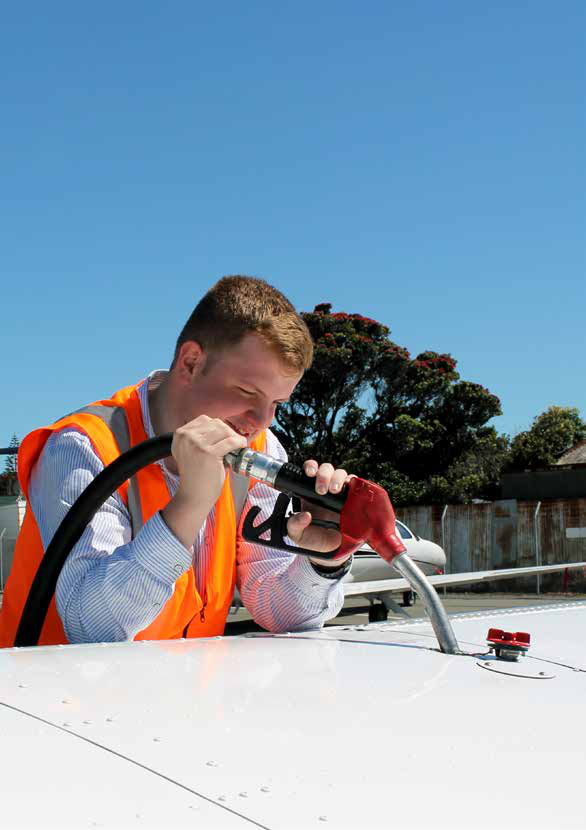
A current NZ Civil Aviation Authority brochure about the safe use of Avgas contains a photo which shows a pilot of a small plane topping up its tank from a 20-litre plastic container (see image below). He leans over the fuel inlet with a relaxed air, wearing no mask, gloves, or goggles. The image recalls the time when leaded petrol was handled with similar casualness. Yet the lead content of Avgas gets no discussion in the brochure, apart from the fact that the fuel is described as 100LL (or low lead) – something of a misnomer given the actual level.
Image from cover of Civil Aviation Authority of New Zealand’s “Fuel Management” document (see reference 21).
The continuing use of leaded Avgas in NZ has received little attention outside the aviation industry. An Official Information Request in November 2023 questioned whether the Ministry for the Environment had commissioned any reports into lead contamination near airports. The answer (redirected to the NZ EPA) was no – and the applicant was advised to contact the relevant regional councils, as they are responsible for monitoring air pollution.26 The EPA also noted, in response to another question, that it does not hold any information about the volume of TEL imported into NZ each year. NZ does provide a related measure from which the total amount of TEL can be calculated – the amount of Avgas imported each year, expressed in gross petajoules. From this we estimate that around five tonnes of elemental lead per year is imported (0.56 g/L×9,000,000 L (imported equivalent) = 5.04 tonnes; as the 0.56 value is for the mass of the Pb component with this being 64% of the mass of TEL). Between 1997 and 2024, there has been a decline in imports of 62.7%, which appears to reflect the move to turbine-engined aircraft that run on jet fuel.4
How well local councils are equipped to monitor the use of Avgas is uncertain, and at present, there appears to be minimal central government oversight over the continued use of leaded fuels. Government monitoring for safety and quality of fuels is mandated, however, under the 2024 National Fuel Plan (primarily to maintain the country’s fuel security).27 Aviation gasoline and racing gasoline are also approved hazardous substances. This approval is subject to a long list of controls, which include specifications for components of the fuel itself, such as permissible limits for aromatic hydrocarbons, benzene and TEL. The limit for lead is 0.85 g/L. This corresponds to the maximum permissible lead level used in NZ gasoline until 1986 (0.84 g Pb/L) and is an indicator of the level still permitted in racing fuel. Controls for many other items are set out in the regulations, ranging from labelling, data sheets, quantities and types of storage to disposal, while there are environmental and tolerable exposure limits for water and air for fuel components such as benzene and toluene.28
Despite these requirements, the safe handling of leaded fuel in NZ seems to have been left largely up to its importers and distributors. Even before the closure of the Marsden Point Oil Refinery in April 2022, leaded aviation and motor fuel was imported as a fully blended product. Avgas is shipped to three primary ports: Mt Maunganui, Port Taranaki, and Lyttelton. The importer of Avgas at the wholesale level is BP, and other firms that sell Avgas are Mobil, Z Energy, and Timaru Oil Services (Tasman Fuels Terminals).
These companies issue detailed instruction manuals about the safe handling and storage of their products. Z Energy, for example, states in its introductory data sheet that ‘Avgas 100LL is produced to stringent manufacturing specifications and is checked at defined points in the supply chain to ensure it is clean, dry and free from contamination.29
What is less clear is how carefully these instructions are followed by the users or local distributors. There are multiple points at which the fuel is made available, which opens the way for less satisfactory safety practices and disposal. These places include tanks at sites where access is not necessarily supervised by an operator but is made available through a code, as in the extensive distribution chain of the company RD Petroleum Avgas. This company supplies Avgas throughout the South Island and in the North Island it distributes BP Avgas. Among its 60 refuelling stations, there are 24 card-operated self-service dispensers.30 RD Petroleum has a comprehensive set of safety protocols for handling Avgas but ensuring that these directions are always followed seems inherently a complicated task.
The safety management of leaded motor racing fuel is even more complex, because its importation and distribution are far more fragmented. It comes into the country under the heading of specialty and industrial chemical imports and in smaller amounts that meet the requirements of individual customers, such as motorsport fuel distributors. This means that it typically arrives in containers in drums, rather than in bulk supply. Worksafe NZ outlines in detail how such hazardous substances can be safely stored and handled,31 though the variety of ways these products get to customers and how they are used makes it difficult to ensure these safety protocols are being followed. There is a huge range of options for motor sport fuels, with firms such as VP Racing Fuels and Sunoco able to provide products customised for vintage cars and activities such as motocross and drag racing. Some offshore suppliers offer ethanol/TEL blends produced by these firms as well as petrol/TEL blends.32
A Canterbury supplier, Challenge Waimak, offers 100+ octane gas for ‘serious petrol heads.’33 Motor racing fuel for uses in regional events may contain lead levels higher than in Avgas, in order to achieve octane ratings of over 100,34 but these days much of the high-octane fuel used for major vehicle and motorcycle racing in NZ employs alcohol blends to boost the octane level.35
4. Potential steps in the phase-out process
The phase-out process of leaded fuel in NZ will need consideration of the following main issues:
- A precautionary approach to the continued use of leaded fuels (and to ethylene dibromide) that are hazardous to human health, would imply that this country should also, like the US, adopt a formal resolution to move towards completely unleaded fuel for aviation and motor racing.
- NZ could fast-track any transition by accepting US Federal Aviation Administration (FAA)- approved unleaded alternatives.
- NZ should set a sunset date for the use of leaded fuels but could follow the lead of the FAA and agree that some use of leaded Avgas will also still be permitted during any transition period.36
- Because the US is leading this shift to unleaded fuel, and will be ahead of NZ in factors such as availability of supply for fuels like General Aviation Modifications Inc (GAMI)’s G100UL, or Swift Fuels UL, there may be an interim period during the transition when it could be attractive to owners in the US to sell down their older piston-engined light aircraft to NZ, knowing that in NZ buyers may still be able to access leaded fuel at a time when its use is no longer permitted in the US. NZ has weak controls over the importation of old forms of transport in NZ, as is seen at present by the lowering of charges on the imported older vehicles that are high emitters of the greenhouse gas CO2,37 as well as the continued importation of vehicles that cannot meet the modern emission standard of Euro 6, required for all new cars in the United Kingdom since 2015.38 An anti-dumping rule may therefore be necessary.
- Commentators seem to agree that the new unleaded fuels will be more expensive, in part because the US market for Avgas is less than one tenth of one percent of the size of that for cars. As a result, refiners have limited incentive to establish separate new production facilities.39 These barriers could mean that NZ may be late in the queue for unleaded Avgas.
- The situation for motor sport may be more straightforward, as a variety of methanol/ethanol blends are already available and suitable for this use. As with Avgas, a transitional period may be necessary before a complete ban is possible, but a sunset date should also be set after which only unleaded fuels are permitted.
- The best prospect for change right now in NZ could be greater promotion around health and safety in the handling of leaded fuels. This will alert people in the aviation and motor racing industries to the risks of handling this fuel, as well as increasing awareness of the need for NZ to plan for a future without it.
- It seems unrealistic that regional councils should be responsible for monitoring an initiative like this, unless there is greater support from central government. The use of leaded fuel is a nationwide problem and requires either dedicated financial help to councils for this task or assistance in the form of a unit within government that is specifically responsible for overseeing the transition away from leaded fuel.