Summary
The continuing high prevalence of Long Covid in Aotearoa New Zealand (NZ) and its disabling effects for thousands of us requires a strong coordinated government response, as recommended in a recent OECD report. Data from the New Zealand Health Survey show that 77.7% of adults have had Covid-19, and 9.2% (about 401,000 people) have experienced Long Covid, with nearly half still symptomatic. It affects people of all ages, but prevalence is highest among women and Māori, and is probably underestimated due to continuing infection and reinfection.
The substantial health, social, and economic impacts of Long Covid justify a well-coordinated national response with the goal of prevention and better care for those affected to minimise long-term harms. Specific measures include vaccination, public health and social measures to reduce transmission, improved indoor air quality, and dedicated care and support for affected individuals along with surveillance and research to support effective service delivery and improvement.
The urge to declare the Covid-19 pandemic over is strong, but the reality is that it is still very much with us. Newly released findings from the New Zealand Health Survey (NZHS) confirm that we have a high prevalence of Long Covid, a stark reminder of the pandemic’s persistence.1 Denial means missing opportunities to limit harms.
What did we learn as a result of this release?
Most New Zealanders have had Covid-19 at least once. The data show that 77.7% (almost 4 out of 5; ~3.3 million) adults reported ever having Covid-19. Women (79.8%) reported a higher rate than men (75.5%). Self-reported rates were lower among Pacific adults (71.5%), Asian adults (71.2%), adults living in the most deprived neighbourhoods (70.7%), disabled adults (68.5%), and those aged 65 years or older (64.4%), probably indicating that these groups had fewer opportunities to test.
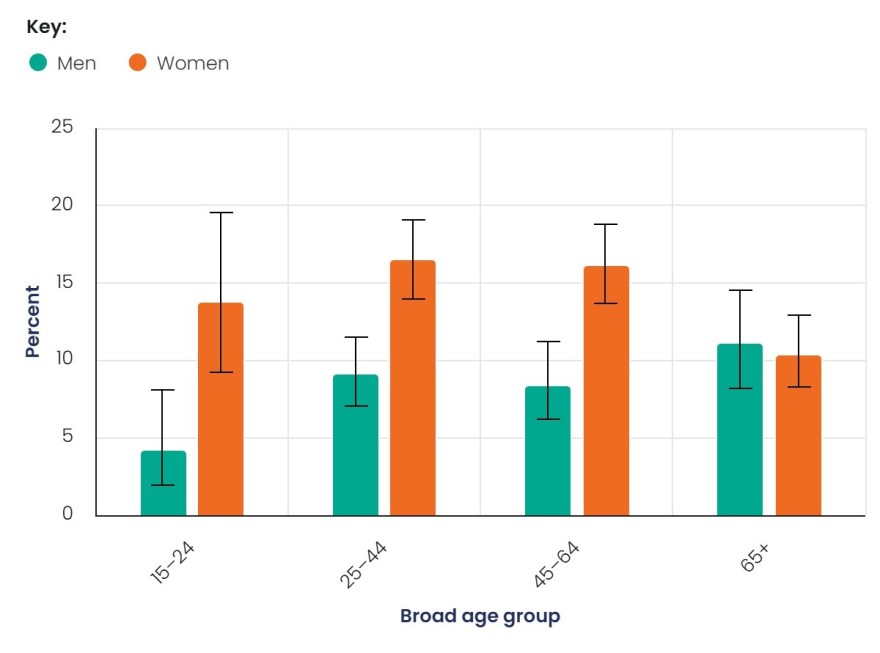
Many people reported a change in health after Covid-19. Respondents who reported ever having Covid-19 were asked if they had experienced Long Covid symptoms, defined as any symptoms lasting three months or more, which they had not had prior to Covid-19 and which were not explained by a different diagnosis. Across NZ, about 1 in 11 adults (9.2%; 401,000 people) reported ever having had Long Covid symptoms. This means that 11.9% of adults who reported ever having had Covid-19 also reported Long Covid. About 1 in 7 women (14.9%) versus approximately 1 in 12 men (8.5%) reported such symptoms. Only among people 65 years and older were the rates similar in women and men (see Figure 1).
Figure 1. Prevalence of people reporting Long Covid symptoms lasting ≥3 months following infection, by age-group and gender. NZHS 2024/25.
Approximately 1 in 6 Māori adults (15.5%) reported Long Covid symptoms, compared to approximately 1 in 9 non-Māori adults (11.3%).
About 185,000 adults (4.3%) reported experiencing Long Covid symptoms at the time they were interviewed in 2024/25 (~117,000 women (5.3%) and ~67,000 men (3.1%)). Thus, almost half (48.5%) were still experiencing symptoms at the time of the survey.
What do these findings mean for NZ?
These NZHS results, backed up by a wealth of evidence from international studies2,3 and previous NZHS research on children,4 show that we need to take Long Covid seriously. Uncontrolled transmission of this virus in our communities is harming health, health services, and productivity.
These findings are our best estimate of Long Covid in adults but are likely now to be an undercount because Long Covid risk increases with reinfection.5 Since the survey, there have been many more Covid cases and NZ is now in its ninth wave, so we can expect more Long Covid. Furthermore, the SARS-CoV-2 virus causes chronic organ damage without symptoms.
These findings are highly concerning. The accepted definition of a rare disease is one case in 2000 people.6 The NZHS Long Covid prevalence is more than a hundred times greater than this. Hence, Long Covid is a burden that needs its own health-service resources.
Why did it take so long for these findings to be released?
Just over 12 months ago, we wrote an extended analysis on the state of Long Covid in NZ, noting that it remained a risk following any Covid infection or reinfection and carried a substantially increased risk of sudden death and silent damage.7 We also noted that vaccination reduces the risk.
We urged the government to establish a coordinated response, as described in that article.7 Very little has been instituted. Even this Long Covid information has only just been released (17 March 2026) and only after a request (3 December 2025) under the Official Information Act; it has been publicised largely by Long Covid Support Aotearoa, not by Health New Zealand, who collected it.8
How should New Zealand respond now?
The evidence on risk factors for Long Covid is quite clear, with three important elements being a history of multiple infections, severity of symptoms during the acute phase, and older age. We know that vaccination reduces both the severity of illness and the risk of repeat infections. Given that Long Covid affects people of all ages (Figure 1), there is a strong argument that vaccination should be recommended for all adults, manifestly challenging the recent change in recommendations to discourage boosters for those under 65 years without any specified indication.9
Crucially, recent research shows that Covid vaccines are still able to deliver meaningful protection.10 Indeed, a very recent report from the OECD notes that prevention of Long Covid can be promoted as a key benefit of Covid‑19 vaccination policy (Box 6.2, page 61 and Section 8.3.1, page 75).11
Running alongside prevention is the need to support those already affected by establishing and maintaining specific tailored care pathways for symptom management and financial safety nets for those unable to work.12 The OECD report specifically argues that the response to Long Covid requires coordinated health policy that includes prevention, a focus on people-centred models of care, and research (Section 8.3, page 75).11
Widening our focus, inaction on respiratory infections is costing us dearly. Long Covid is still very challenging to treat, but much can be done to prevent new cases. One of the most basic, yet effective, measures is promoting a culture of staying home when sick. Additionally, providing a good standard of indoor air quality in public settings through ventilation, air filtration, and far-UVC lighting is highly achievable and has multiple co-benefits in reducing sickness rates from other respiratory infections and improved productivity and learning.13 These measures also improve pandemic preparedness.
Conclusion
The evidence shows that Covid-19 is still a major infectious disease in Aotearoa, with wide-ranging deleterious impacts. Our government can and should be doing much more to protect the population and limit this social and economic harm.
What this Briefing adds
- Long Covid has arguably become the most important health consequence of the pandemic, particularly for countries like NZ, which used an elimination strategy that prevented infection prior to vaccination and thus minimised severe illness and deaths.
- Long Covid remains a common cause of disability, with 4.3% of the adult population reporting Long Covid symptoms at the time they were interviewed in 2024/25.
Implications for policy and practice
- NZ needs a coordinated Long Covid policy and programme that includes prevention, a focus on people-centred models of care, and research – as recommended by the OECD.
- A national Long Covid policy and programme should include:
- Regular Covid vaccine boosters for all adults, requiring a rethink of recent policy changes that discourage boosters for most of those under 65 years.
- Urgent review of Covid vaccine eligibility, recognising the burden of Long Covid in children.
- Promotion of a culture of staying home when sick, use of masks in high-risk environments, and systematic measures to improve indoor air quality in public settings.
- Support for those already affected by Long Covid by establishing and maintaining specific, tailored care pathways for symptom management and financial safety nets for those unable to work.
- Suitable ongoing surveillance and research to guide delivery, evaluation, and service improvement.
This article is adapted from The Conversation under a Creative Commons license. Read the original article.
Authors details
Prof John D. Potter, Centre for Public Health Research, Te Kunenga ki Pūrehuroa | Massey University
Assoc Prof Amanda Kvalsvig, Department of Public Health, Ōtākou Whakaihu Waka, Pōneke | University of Otago, Wellington
Prof Michael Baker, Director, Public Health Communication Centre, and Department of Public Health, Ōtākou Whakaihu Waka, Pōneke | University of Otago, Wellington