Summary
A new interactive online tool allows New Zealanders to check whether their drinking water supply is fluoridated and view the past fluoride concentration of their supply based on monitoring data from public water supplies.
The launch coincides with the publication of an analysis of tooth decay rates in over 630,000 preschool-aged children in Aotearoa New Zealand (NZ), which confirms lower rates of tooth decay associated with community water fluoridation. The findings provide contemporary evidence that fluoridation remains an effective public health intervention (despite likely dilution of its effects due to widespread use of fluoride toothpaste and improvements in dental care) and highlight the importance of ensuring equitable access to fluoridated drinking water and maintaining fluoridation systems at recommended fluoride levels.
What is community water fluoridation?
Community water fluoridation is the controlled adjustment of fluoride concentrations in drinking water to levels that help prevent tooth decay.1 It has been used in NZ for more than 60 years and is recognised internationally as one of the most effective population-level interventions for improving oral health.1
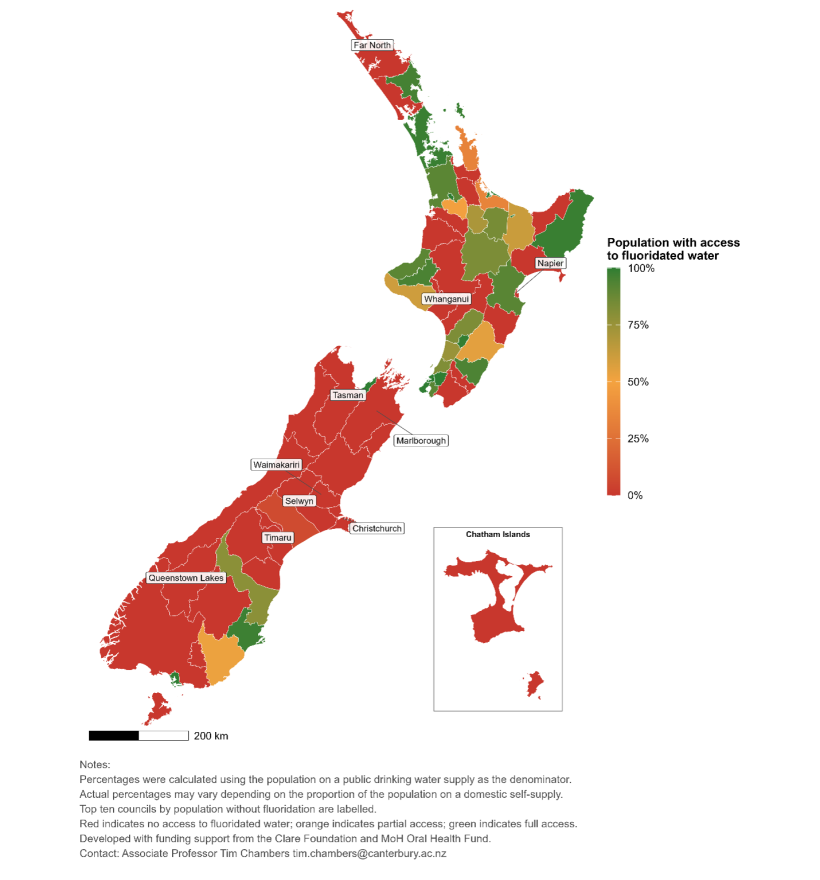
In 2021, Parliament passed the Health (Fluoridation of Drinking Water) Amendment Act, enabling the Director-General of Health to direct water suppliers to fluoridate drinking water supplies.2 Subsequently, fluoridation coverage has increased substantially.3 Figure 1 shows the current population-level coverage of fluoridation by Territorial Authority.
Figure 1: Percentage of population with access to community water fluoridation in 2026 by Territorial Authority.
Despite this expansion, water fluoridation remains a topic of public debate. Much of the discussion has focused on potential health effects and whether it remains necessary given the widespread availability of fluoride toothpaste and dental services.
What does the new study show?
Our analysis published in the Journal of Community Dentistry and Oral Epidemiology included oral health screening data from 630,926 NZ children aged four years, collected through the B4 School Check programme from 2010 to 2022.4 The analysis spatially linked each child’s place of residence to a water supply as well as data on fluoridation histories.
Overall, 14.2% of children were recorded as having early childhood tooth decay. After accounting for ethnicity, deprivation, age, sex, rurality and year of assessment, children living in non-fluoridated areas experienced significantly higher rates of tooth decay than children living in fluoridated areas.
We estimated that approximately 4.4% of tooth decay detected among four-year-olds could be attributed to a lack of community water fluoridation, equivalent to around 282 cases annually across NZ.
The study also found substantial inequities in oral health. Māori and Pacific children experienced considerably higher rates of tooth decay than European children, regardless of fluoridation status. While fluoridation was protective overall, the magnitude of benefit varied between ethnic groups, highlighting the need for broader strategies to address oral health inequities.
Why is a new fluoridation tool needed?
Obtaining information about fluoridation coverage and fluoride monitoring results has historically been difficult for the public, researchers and policymakers.5
The new online dashboard brings together information from public drinking water supplies across NZ and allows users to:
- identify whether a public drinking water supply is fluoridated
- view annual median fluoride concentrations from monitoring results
- compare performance between supplies against recommended fluoride levels
- explore geographic variation in fluoridation coverage.
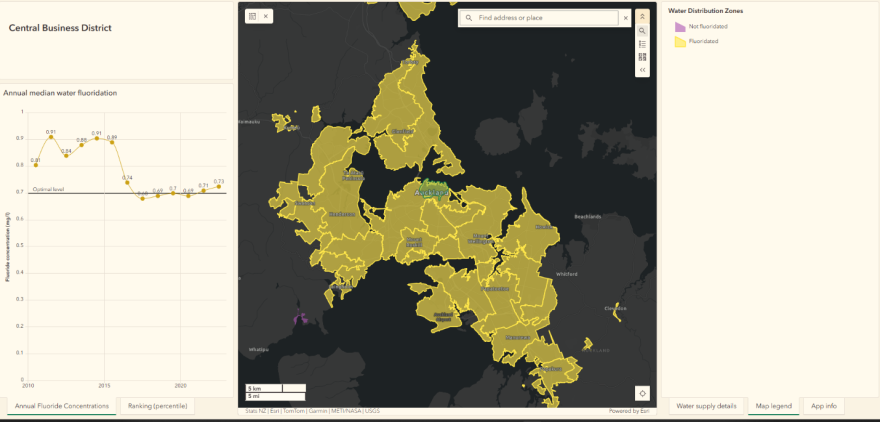
The tool increases transparency around fluoridation and enables communities to better understand the quality and characteristics of their drinking water supplies (Figure 2). The tool can be accessed here https://tinyurl.com/fluoridationindex and any comments can be sent here [email protected]. This work has been supported by the Clare Foundation
Figure 2: Screenshot of the interactive community water fluoridation map showing the Auckland region and associated data.
What does the dashboard reveal?
The dashboard shows substantial variation in fluoridation coverage across NZ. While recent policy changes have increased access to fluoridated water, many communities remain unfluoridated or have only recently begun fluoridation.
The monitoring data also illustrate that maintaining fluoride concentrations within the recommended range remains an operational challenge for some water suppliers, consistent with our previous work.3 This is important because the effectiveness of fluoridation depends not only on whether fluoride is added, but whether concentrations are consistently maintained at optimal levels (between 0.7-1.0 mg/L).
The dashboard therefore provides a valuable accountability mechanism, enabling communities, regulators and researchers to assess how effectively fluoridation programmes are being implemented.
The dashboard only contains fluoride measurements up until 2021. However, updated data could be integrated with support from Territorial Authorities, Ministry of Health and the Water Services Authority – Taumata Arowai.
What is new in this Briefing?
- A new nationwide study of more than 630,000 children found that living in a fluoridated area was associated with lower rates of early childhood tooth decay after accounting for sociodemographic factors.
- A new public dashboard allows New Zealanders to view fluoridation coverage and fluoride monitoring results for public drinking water supplies.
- The dashboard provides unprecedented transparency regarding fluoridation implementation and performance across NZ.
Implications for policy and practice
- The new study provides some of the strongest contemporary NZ evidence that community water fluoridation remains an effective public health intervention for preventing childhood tooth decay.
- The findings support ongoing implementation of fluoridation directives and reinforce the importance of maintaining fluoridation systems at recommended levels.
- The launch of the fluoridation dashboard also represents an important step towards greater transparency in drinking water management. Public access to fluoridation and monitoring information can help build trust, support evidence-informed decision-making and identify opportunities for improving system performance.
- However, fluoridation alone will not eliminate oral health inequities. Persistent disparities in tooth decay among Māori and Pacific children indicate that broader action is needed to address structural determinants of oral health, including access to preventive dental services, healthy food environments and wider socioeconomic inequities.
Authors' details
Associate Professor Tim Chambers, Ngāi Tahu Research Centre, Te Whare Wānanga o Waitaha | University of Canterbury
Professor Jonathan Broadbent, Department of Oral Health, Whakaihu Waka, | University of Otago
Professor Philip Schluter, Faculty of Health, Te Whare Wānanga o Waitaha | University of Canterbury
Associate Professor Matt Hobbs, School of Health Sciences, Te Whare Wānanga o Waitaha | University of Canterbury
Dr Lukas Merek, Geospatial Research Institute, Te Whare Wānanga o Waitaha | University of Canterbury
Christina Pike, Te Whare Wānanga o Waitaha | University of Canterbury
Frank Dean, Ngāi Tahu Research Centre, Te Whare Wānanga o Waitaha | University of Canterbury