Summary
As the Ministry of Health is updating its eating guidelines for children and young people, two new publications describe a co-creation process with rangatahi Māori to develop and disseminate the Manora Rangatahi Guidelines for Eating and Wellbeing.
Using wānanga processes, 17 rangatahi incorporated international guideline exemplars, expert opinion, te ao Māori concepts, and structured peer feedback into the development of 10 healthy, sustainable eating messages and 10 wellbeing messages (exercise, sleep, screen time, respect, cyber safety). Most messages were invitational (‘Let’s try to…’), qualitative (eg no specified serving sizes or frequencies), explanatory (providing reasons) and holistic in a Māori sense – incorporating concepts of mauri, whānau, and tūrangawaewae.
Rangatahi also co-designed a 22-week social media campaign and starred in the video clips. The campaign achieved more than 1.48 million impressions and over 19,000 engagements (eg, likes, comments, sharing).
To achieve relevance and credibility, eating and wellbeing guidelines need to be co-designed with target audiences.
Dietary guidelines are foundational for creating messages about healthy eating and food policies and programmes, such as for Ka Ora, Ka Ako, the free lunch programme.1 The Ministry of Health is revising its outdated healthy eating guidelines for children and young people, which were developed in 2012 and updated in 2015.2 It is not clear whether the Ministry will engage youth in the process, incorporate mātauranga Māori, include emerging issues of ultra-processed food or sustainable eating patterns, or incorporate wider wellbeing recommendations.
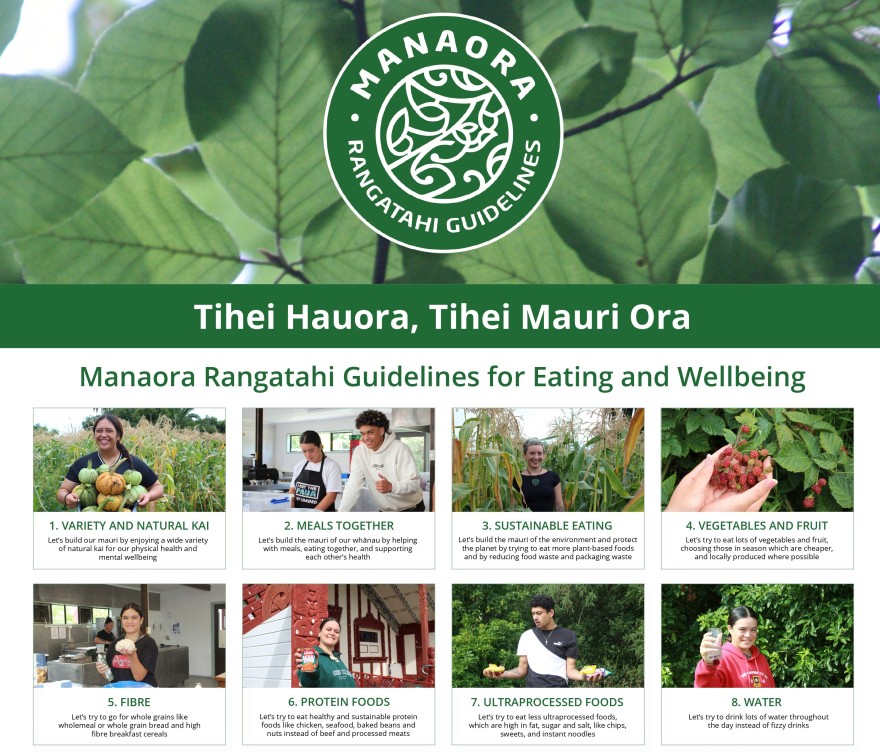
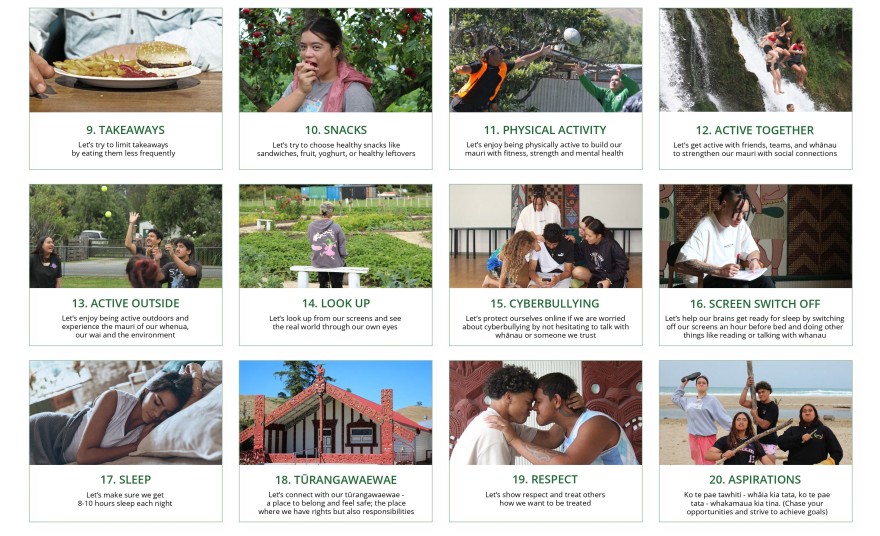
Two highly relevant papers have just been published that describe the co-development3 and pilot dissemination4 of the Manaora Rangatahi Guidelines for Eating and Wellbeing (Figure 1). The studies were part of the Nourishing Hawke’s Bay: He wairua tō te kai project and this Briefing summarises the findings and considers the implications for guideline development and dissemination in Aotearoa New Zealand.
Figure 1: Detail from Manaora Rangatahi Guidelines for Eating and Wellbeing poster. Full poster and other materials available here.
A different approach – co-creation
The Nourishing Hawke’s Bay team partnered with 17 rangatahi Māori from four Hawke’s Bay secondary schools to co-create the Manaora Rangatahi Guidelines: ten eating messages and ten wellbeing messages for all young people.1 The co-design followed a tikanga Māori practice across three wānanga at a local marae. Rangatahi absorbed the evidence base and purpose of guidelines, critiqued exemplars provided from New Zealand, Brazil, Chile, Mexico, Norway and USA, worked with Māori community and scientific informants, incorporated te ao Māori concepts, and added their own ideas and ‘flavour’ over five days to develop 20 draft guidelines.
Ninety-one peer rangatahi across four schools provided structured feedback on the draft guidelines with 17/20 messages receiving agreement ratings above 70%. Four messages were revised through that feedback process. Messages on sustainability, ultra-processed foods, sugary drinks and takeaways were the most challenging to develop, which is why it was so important that these messages were not avoided. The critical features of the final set of guidelines are shown in Box 1.
Box 1: The defining features of the Manaora Rangatahi Guidelines
- The eating guidelines include messages on sustainable food choices and ultra-processed food.
- The wellbeing guidelines cover exercise, sleep, screen time, cyberbullying, and mutual respect.
- The social dimensions of kai and physical activity are explicit.
- The guidelines are invitational (‘Let’s…’) and acknowledge the challenges of meeting the guidelines (‘Let’s try to…’).
- The concepts of mauri (life force) run through multiple messages and tūrangawaewae, (a place of belonging and responsibility) appears as a standalone wellbeing message.
- The guideline’s name ‘Manaora’ (a neologism combining mana and ora), inspirations (‘Tīhei Hauora, Tīhei Mauri ora’), aspirations (the closing whakatauki), images and design features create a strong Māori flavour to connect with the target group.
- Short, lay explanations provided in first person for each guideline with references.
The dissemination model – rangatahi as authors as well as audience
The same rangatahi co-created a 22-week digital media campaign across TikTok, Instagram, and YouTube.2 They chose the platforms, recruited Māori influencers, filmed content on the marae and the surrounding area, and made decisions by consensus.
The campaign achieved more than 1.48 million impressions and over 19,000 engagement actions at a total cost of NZ$125,000. Instagram engagement was 6.2% against an industry median of 0.36%. Cost per thousand TikTok impressions was NZ$0.09. This is comparable to or better than government campaigns with much larger budgets.
These figures, however, describe reach and resonance, not behaviour change. But for a first-of-its-kind, rangatahi-led public health campaign on a minimal budget, the results posit that the model works at scale.
Implications
The nutrition, food security, and mental health challenges for rangatahi are enormous nationally5,6 and especially in Hawke’s Bay.7 Healthy eating and wellbeing guidelines are foundational for communication and policy. While 17 rangatahi from one region of New Zealand is not a national sample and campaign reach and resonance is not behaviour change, these papers show that modern co-creation and dissemination methods for guidelines, including on challenging issues, can achieve very positive results.
This co-creation approach with rangatahi is important for the Ministry of Health to engage with if it is serious about achieving world-leading, relatable, credible guidelines which grapple with the eating and wellbeing issues facing rangatahi today.
What this Briefing adds
- A group of rangatahi Māori demonstrated that modern co-creation approaches can develop holistic, relevant and up-to-date eating and wellbeing guidelines.
- The eating guidelines readily incorporated current issues of ultra-processed foods and sustainable eating, and the broad wellbeing guidelines included exercise, sleep, screen time, respect and cyber safety.
- Māori concepts of mauri, whānau, and tūrangawaewae added significantly to the holistic and comprehensive approach to health.
- The pilot social media dissemination campaign, which featured video clips of the rangatahi delivering the messages, achieved a very promising audience reach.
Implications for policy and practice
- Rangatahi Māori can readily incorporate international guideline exemplars, expert opinion, te ao Māori concepts, and structured peer feedback into co-created guidelines and their dissemination.
- The Ministry of Health, which is currently revising its eating guidelines for adolescents and young people, could incorporate modern co-creation processes to update guidelines to increase their relevance to youth.
Authors details
Prof Boyd Swinburn, School of Population Health, University of Auckland | Waipapa Taumata Rau
Prof David Tipene-Leach (Ngāti Kahungunu), Te Kura i Awarua Rangahau Māori Research Centre, Eastern Institute of Technology | Te Aho a Māui