
APA style

Hoek, J., & Gendall, P.
. Helping smokers quit: The case for tobacco pack inserts. Public Health Expert Briefing. https://www.phcc.org.nz/briefing/helping-smokers-quit-case-tobacco-pack-inserts

Vancouver style

Hoek J, Gendall P. Helping smokers quit: The case for tobacco pack inserts. Public Health Expert Briefing. . https://www.phcc.org.nz/briefing/helping-smokers-quit-case-tobacco-pack-inserts

Aotearoa New Zealand (NZ) has a goal of reducing smoking prevalence rapidly and equitably. However, reliance on conventional cessation measures, such as pictorial warning labels, has not reduced substantial inequities between Māori and non-Māori. Warning labels communicate important harms, but do not provide advice on quitting or inspire people who smoke to believe they can quit. 

Our recent study found that efficacy inserts, small cards placed inside tobacco packages, offering advice on smoking cessation, could be a highly effective, low-cost way to support smoking cessation in NZ. 

Since the Smokefree Environments Act was first introduced in 1990, tobacco control policy has focussed on demand-side measures, particularly tax increases, health warnings, and reducing the visibility of tobacco products in stores. The effectiveness of demand-side measures has a strong evidence base and they have played a key role in prompting the long-term declines in smoking prevalence seen in NZ until 2023,1-4when smoking prevalence plateaued.5

However, despite the success and importance of demand-side measures, population groups experiencing sustained inequities caused by smoking may reject policies they perceive as didactic, or react against measures they believe constrain their “choices”.6, 7 People who smoke and who have not been able to quit, despite multiple attempts, may interpret current policies as increasing the pressure to quit without supporting their capacity to do so. As a result, they may discount health information, exempt themselves from the risks shown, and become less likely to make a quit attempt.6, 8

These rationalisations sit uneasily alongside the high regret that a large majority of people who smoke experience; many wish they had never started smoking and would like to become smokefree.9-11 Managing the apparent contradiction between rationalisation and regret requires new policies that encourage smoking cessation by complementing measures that deter tobacco uptake and ongoing use.

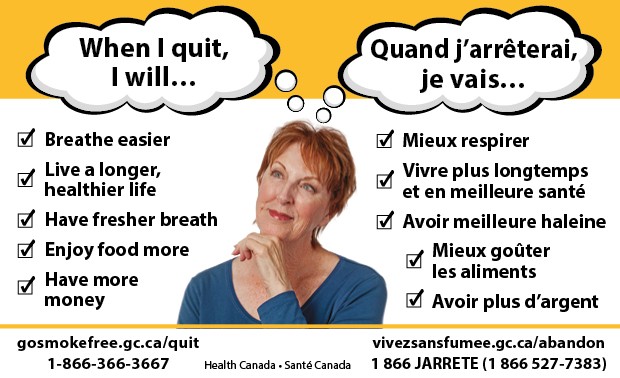
We have conducted several studies examining whether efficacy messaging – messaging that increases people’s belief they can stop smoking and emphasises the benefits of not smoking -- could complement on-pack warnings and increase the likelihood people will make quit attempts. Preliminary work involving in-depth discussions with people who smoke found they would welcome advice that could help them quit.12 We identified themes people would find motivating, including the importance of family, the financial burden of smoking, and maintaining good health.12 We developed these ideas into pack efficacy insert prototypes, using ideas from Canada, which has required pack inserts for more than a decade,13 and Australia, which has just mandated these inserts,14 and then tested responses to insert components using two discrete choice experiments.15

Canadian tobacco pack insert example featuring woman thinking when I quit I will - breathe easier" etc

Above: Example of health information messages on the inside of cigarettes, little cigars, and cigarette tobacco packages mandated in Canada. Source: Health Canada, 2026. Reproduced with the permission of the Minister of Health, 2026.

Our sample of 970 respondents included people who smoked daily or weekly, or who had recently quit smoking; we oversampled Māori respondents so we could compare response patterns from Māori and non- Māori respondents. Respondents evaluated sets of inserts that compare themes (price, health or family); headline styles (questions or statements) and message formats (informational or testimonial); they identified the elements they thought would increase confidence in quitting and be seen as helpful to someone thinking about quitting. 

We found strong support for affirming messages that could complement warning labels. Māori respondents, people aged under 35 and people with children aged under 16 were especially responsive to family-oriented themes – themes that emphasised the effect of smoking on whānau and intergenerational wellbeing. Many Indigenous populations understand smoking’s harms relationally and place a high priority on whānau wellbeing and the health and wellbeing of future generations; these themes resonated with Māori communities and parents, and could motive quit attempts more effectively than themes that focus on individual benefits. 

When considering specific efficacy messages, respondents saw price-related informational messages as most helpful. Given NZ’s high tobacco prices and cost-of-living pressures, financial themes have high salience and quitting offers a pathway to greater economic stability. Combining messages that promote financial savings alongside improved family wellbeing could capitalise on these dual concerns.

We also found headlines framed as questions performed better than statement headlines; questions appear to encourage reflection and, rather than direct a particular action, prompt people to consider their motivations and goals.16 Informational messages performed more strongly than testimonials, though further work to compare shorter and simpler messages is still required.

Our findings have important implications for tobacco control policy. Efficacy inserts would be relatively inexpensive to produce (costs would be borne by tobacco companies, in the same way as other packaging requirements are a cost of doing business). Inserts could feature multiple themes, be updated and extended easily as new evidence comes to light, and could be introduced alongside updated warning labels;17 NZ’s on pack warning labels have not been refreshed since their introduction in 2018 and are showing signs of wear out.6 Our study highlights the need for multiple communication themes and suggests varying insert themes, images and content could increase engagement with priority populations and reduce inequities. In particular, our work reinforces the need for approaches that will resonate with Māori, who continue to bear a heavy burden of harm from smoking. 

Instead of treating tobacco packaging solely as a harm communication medium, the Government has an opportunity to promote agency, foster hope, and outline the benefits of quitting. Failure to introduce efficacy inserts represents a missed opportunity to adopt international best practice and support the population groups most affected by smoking’s harms.

What this Briefing adds

  • People who smoke found efficacy inserts that build confidence in quitting and emphasise the benefits of becoming smokefree helpful and likely to build confidence in quitting.
  • Themes illustrating smokefree benefits to families and whānau resonated with Māori, younger adults and parents; price-related informational messages were seen as helpful in motivating quit attempts. 
  • Introducing efficacy inserts is an international best-practice measure that complements on-pack warning labels. 

Implications for policy and practice

  • New Zealand should mandate the use of efficacy inserts as these represent a low-cost, evidence-based approach that aligns with policy implemented in Canada and Australia. 
  • Tobacco control messages should extend the current deterrence-based messaging and incorporate supportive efficacy messages that increase people’s confidence and capacity to quit smoking. 
  • Efficacy messages should prioritise themes that resonate strongly with priority groups; whānau-centred approaches, in particular, could help address persistent smoking inequities. 

Authors details 


Prof Janet Hoek, Co-Director of ASPIRE Aotearoa Research Centre, and Department of Public Health, Ōtākou Whakaihu Waka | University of Otago

Dr Philip Gendall, ASPIRE Aotearoa Research Centre. Emeritus Professor (Massey University) and Honorary Senior Research Fellow in the Dept of Public Health, Ōtākou Whakaihu Waka | University of Otago

Creative commons

Public Health Expert Briefing (ISSN 2816-1203)

References

  1. Jha P, Peto R. Global effects of smoking, of quitting, and of taxing tobacco. New England Journal of Medicine. 2014;370(1):60-8. https://www.nejm.org/doi/full/10.1056/NEJMra1308383
  2. Hammond D. Health warning messages on tobacco products: A review. Tobacco Control. 2011;20(5):327-37. DOI: 10.1136/tc.2010.037630
  3. Henriksen L, Feighery EC, Wang Y, Fortmann SP. Association of retail tobacco marketing with adolescent smoking. American Journal of Public Health. 2004;94(12):2081-3. doi: 10.2105/ajph.94.12.2081
  4. Hoek J, Gifford H, Pirikahu G, Thomson G, Edwards R. How do tobacco retail displays affect cessation attempts? Findings from a qualitative study. Tobacco Control. 2010;19(4):334-7. DOI: 10.1136/tc.2009.031203
  5. Nip J, Edwards R, Hoek J, Waa A, Teddy L. Smoking prevalence and trends: Important findings from the 2024-25 New Zealand Health Survey Wellington: Public Health Communications Centre; 26 Nov, 2025  https://www.phcc.org.nz/briefing/smoking-prevalence-and-trends-important-findings-2024-25-new-zealand-health-survey.
  6. Ozarka E, Teddy L, Blank M, Waa A, Hoek J. Managing fear responses: A qualitative analysis of pictorial warning labels five years post-plain packaging. Nicotine & Tobacco Research. 2024;27(6):1059-65. https://doi.org/10.1093/ntr/ntae112
  7. Hall MG, Sheeran P, Noar SM, Boynton MH, Ribisl KM, Parada H, et al. Negative affect, message reactance and perceived risk: how do pictorial cigarette pack warnings change quit intentions? Tobacco Control. 2018;27(e2):e136-e42. doi: 10.1136/tobaccocontrol-2017-053972
  8. Hoek J, Hoek-Sims A, Gendall P. A qualitative exploration of young adult smokers' responses to novel tobacco warnings. BMC Public Health. 2013;13(609). DOI: 10.1186/1471-2458-13-609
  9. Fong G, Hammond D, Laux F, Zanna M, Cummings K, Borland R. The near-universal experience of regret among smokers in four countries: Findings from the international Tobacco Control Policy Evaluation Survey. Nicotine & Tobacco Research. 2004;6(3):S341-S51. DOI: 10.1080/14622200412331320743
  10. Hoek J, Waa A, Edwards R, Ozarka E. High regret among people who smoke reinforces strong support for smokefree legislation. The Briefing 2024 (20 Feb)  https://www.phcc.org.nz/briefing/high-regret-among-people-who-smoke-reinforces-strong-support-smokefree-legislation.
  11. Wilson N, Edwards R, Weerasekera D. High levels of smoker regret by ethnicity and socioeconomic status: national survey data. New Zealand Medical Journal. 2009;122(1292):99-100.
  12. Teddy L, Ozarka E, Blank M-L, Waa A, Hoek J. A hopeful journey: Responses to efficacy labels from people using RYO tobacco in Aotearoa New Zealand. Tobacco Control. 2025. DOI: 10.1136/tc-2024-059164
  13. Thrasher JF, Swayampakala K, Cummings KM, Hammond D, Anshari D, Krugman DM, et al. Cigarette package inserts can promote efficacy beliefs and sustained smoking cessation attempts: a longitudinal assessment of an innovative policy in Canada. Preventive Medicine. 2016;88:59-65. 10.1016/j.ypmed.2016.03.006
  14. Department of Health and Aged Care. Laws begin a new era of tobacco control Australia: Australian Government; 2023 [updated 07 December. Available from: https://www.health.gov.au/ministers/the-hon-mark-butler-mp/media/laws-begin-a-new-era-of-tobacco-control.
  15. Gendall P, Eckert C, Burke P, Teddy L, Waa A, Hoek J. Evaluation of in-pack efficacy inserts: Two discrete choice studies from Aotearoa New Zealand. Tobacco Control. 2026. doi: 10.1136/tc-2025-059789
  16. Glock S, Müller BCN, Ritter S. Warning labels formulated as questions positively influence smoking-related risk perception. Journal of Health Psychology. 2012;18(2):252-62. DOI: 10.1177/1359105312439734
  17. Gendall P, Eckert C, Burke PF, Teddy L, Waa A, Hoek J. How Do People Who Smoke Respond to Novel Tobacco Pack Warnings? Two Cross-Sectional Studies from Aotearoa New Zealand. Nicotine & Tobacco Research. 2025;28(3):454-63. https://doi.org/10.1093/ntr/ntaf167

About the Briefing

Public health expert commentary and analysis on the challenges facing Aotearoa New Zealand and evidence-based solutions.

Subscribe

Briefing CTA

Public Health Expert Briefing

Get the latest insights from the public health research community delivered straight to your inbox for free. Subscribe to stay up to date with the latest research, analysis and commentary from the Public Health Expert Briefing.