Summary
This month the Public Health Communication Centre marks its third anniversary. Over the past three years, we have worked to increase the reach and impact of public health research in Aotearoa New Zealand through our Public Health Expert Briefings. As we reflect on our progress, we are also looking ahead. Feedback from stakeholders and readers affirms the value of independent, accessible, evidence-informed analysis. In our fourth year, we aim to deepen that impact by placing greater emphasis on evaluating existing policies, strengthening our ethical framework, and sustaining attention on major structural drivers of health, including climate change and commercial determinants. We will also support democratic processes by giving our major political parties an opportunity to present and contrast their policies across key public health issues, as we did in our first year of operation in 2023.
This month, the Public Health Communication Centre (PHCC) marks its third anniversary. This Briefing reviews our progress over the last three years, adding to similar articles published after our first1 and second year2 of operation.
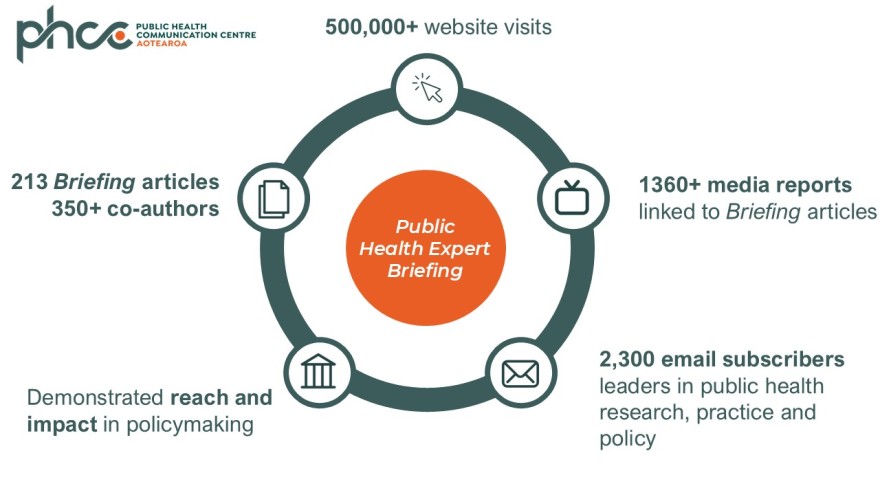
Over the last three years we have highlighted public health research, evidence and analysis to an increasingly large audience, as noted in our summary graphic below (Figure 1). We will continue to use the Briefing as our main channel for reaching both the public in Aotearoa New Zealand, as well as key decision makers in government. But we are also eager to build on this work and explore other avenues for achieving our core purpose.
Figure 1. Overview of the impact of the Briefing
Evaluating ourselves and public health
Last year, we undertook two evaluation exercises to better understand how our work is perceived and how it might improve.
First, we consulted representatives from key stakeholder groups, including public health physicians, researchers, senior policy professionals, and health and science journalists. Second, we surveyed our subscribers, readers who receive notifications of new Briefings and monthly updates.
Feedback in both cases was strongly positive. Respondents valued the independence of the Centre, the accessibility of our writing, and the consistency of output. There were also constructive suggestions. These included managing the timing of outputs to avoid overwhelming readers, and a clear signal that there is little appetite for AI-generated material in this space. Readers value authenticity, expertise, and accountability.
Evaluation should not apply only to communications. A healthy public health system depends on continuous learning: assessing what works, what does not, and why.3,4
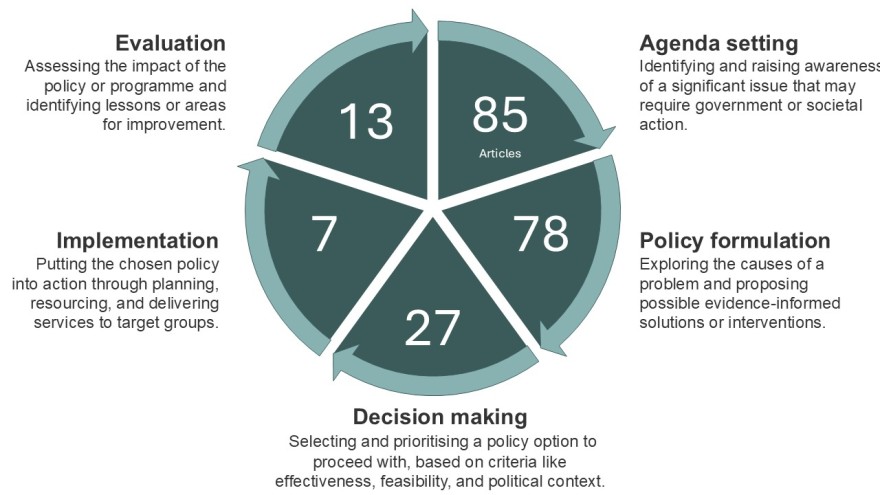
Reviewing our Briefings over the past three years, we found that much of our work has concentrated on the early stages of the idealised policy cycle5; Briefing articles often focus on identifying problems and proposing potential solutions. This reflects the reality that many pressing public health challenges require urgent recognition and evidence-informed responses.
Figure 2. Policy cycle placement of Briefing articles, 2023-2026
Note: Many Briefings cover multiple aspects of the policy-making process. Articles were coded by PHCC staff according to what was judged to be the primary focus. Results should be considered indicative only.
Topics covered by the Briefing are summarised in the Appendix. Not surprisingly, the focus of the last 12 months has shifted from the preceding two years, which reflected responses to major policy changes such as the repeal of Aotearoa’s world-leading smokefree legislation6, threats to Ka Ora, Ka Ako (the Healthy School Lunch Programme)7 and response to the continuing Covid-19 pandemic.8 Issues covered in the last 12 months focused on a wider range of topics including social media, climate change and wider nutrition issues.9–11
As we move into our fourth year, we are keen to place greater emphasis on evaluation: examining how existing policies and programmes are performing, within and beyond central government, and whether they are delivering intended health and equity outcomes. And how they could be improved and what we can learn for future policy responses and interventions.
Previous evaluation-focused Briefings have included analyses of the Ka Ora, Ka Ako school lunches programme12 and assessments of vaping starter kits for smoking cessation.13 We intend to build on this work by encouraging and soliciting Briefings examining implementation, outcomes, and unintended consequences across a wider range of initiatives.
We will also support democratic processes by giving our major political parties an opportunity to present and contrast their policies across major public health issues, as we did in our first year of operation in 2023.14 Assessing the performance of our political parties is itself a major evaluation process that benefits from using a systematic approach informed by evidence.
Our place in the Public Health landscape
The PHCC occupies a distinctive and, we believe, valuable space within Aotearoa’s public health system.
Thanks to philanthropic support, we are able to focus entirely on our core purpose: increasing the reach and impact of public health research and evidence.15 We do not operate under a commercial imperative, nor are we required to defend the actions of a parent institution. We are guided instead by foundational public health principles: prevention, equity, sustainability, and intergenerational wellbeing.3,16,17
We provide a platform for researchers and practitioners to advocate for practices, policies and approaches supported by scientific evidence and capable of improving population and environmental health and equity.
Now that the PHCC is an established part of the landscape, we are reviewing how we prioritise issues and partnerships. Our aim is to further develop a responsible ethical framework to guide editorial decision-making — ensuring transparency, consistency, and strategic clarity in how we operate.
Three years in, we remain committed to our founding purpose. If the first phase was about establishing a trusted voice, the next will be about deepening impact. We will do this through careful evaluation, sustained attention to structural drivers such as climate change and commercial determinants, and continued commitment to independent, evidence-informed communication in Aotearoa New Zealand.
What this Briefing adds
- Briefing articles continue to cover a wide range of public health subject areas, with a changing focus in the last year in response to emerging issues (such as the increasing risk of a measles epidemic and intensifying climate change impacts).
- Briefings have contributed to all phases of the policy cycle, with a particular focus on agenda setting and policy formulation.
Implications for policy and practice
- The PHCC is keen to place greater emphasis on future Briefings that support evaluation of how existing policies and programmes are performing at delivering intended health and equity outcomes.
- In election year, this evaluation focus will extend to giving our major political parties an opportunity to present and contrast their policies across major population health issues, as we did in our first year of operation in 2023.
- The PHCC is committed to maintaining and improving its processes to ensure high standards of communication ethics and will work to develop an explicit statement covering this aspect of its work.
Implications for readers
- To stay up to date on the latest research and commentary from the PHCC, consider subscribing and get new articles delivered straight to your inbox.
- If you are a public health researcher or practitioner interested in contributing a Briefing article, please get in touch.
- If you have any feedback on the Centre, the Briefing, and how we can better inform advances in public health, please let us know.
Authors details
Prof Michael Baker, Director, Public Health Communication Centre, Department of Public Health, Ōtākou Whakaihu Waka, Pōneke | University of Otago, Wellington
Dr John Kerr, Science Lead, Public Health Communication Centre, Department of Public Health, Ōtākou Whakaihu Waka, Pōneke | University of Otago, Wellington
Adele Broadbent, Communication Lead, Public Health Communication Centre, Ōtākou Whakaihu Waka, Pōneke | University of Otago, Wellington
Marnie Prickett, Research Fellow, Department of Public Health, Ōtākou Whakaihu Waka, Pōneke | University of Otago, Wellington
Fiona Taylor, Public Health Communication Centre, Ōtākou Whakaihu Waka, Pōneke | University of Otago, Wellington
Professor Simon Hales, Co-Director, Public Health Communication Centre, and Department of Public Health, Ōtākou Whakaihu Waka, Pōneke | University of Otago, Wellington
Prof Nick Wilson, Co-Director, Public Health Communication Centre, and Department of Public Health, Ōtākou Whakaihu Waka, Pōneke | University of Otago, Wellington
Acknowledgements
We take this opportunity to thank all the Briefing contributors; the Public Health Expert Briefing Editors/Associate Editors: Richard Edwards, Cristina Cleghorn, Kim O’Sullivan, Tim Chambers, Helen Eyles; the PHCC Advisory Board: Dacia Herbulock, Anaru Waa, Peter Griffin, Teresa Wall, Boyd Swinburn and Richard Sutherland; and those who have undertaken secondments/internships with the PHCC: Osman Mansoor and Jonathan Jarman.
Appendix
Appendix: Additional information on the classification of Briefing articles
Topic areas covered
This classification of articles aimed to identify the dominant intent of the article and assign a specific topic. Most topics focussed on health threats (eg, smoking, vaccine preventable diseases). Some focussed on populations (eg, children and youth), or processes (eg, public health surveillance). Briefing articles focused on PHCC operations were excluded.
To make the analysis more manageable, these topics were then grouped into broad areas covering closely related topics (eg, Public health policy, Decision-making, and Infrastructure were grouped into Public health leadership & Capabilities) (Table 1).
Table 1. Number of Briefing articles exclusively classified by broad topic area, by each year of the PHCC’s operation starting in February 2023.
| Broad topic area | Feb 2023 - Jan 2024 | Feb 2024 - Jan 2025 | Feb 2025 - Jan 2026 | Total | Total (%) |
| Nicotine, smoking & vaping | 15 | 19 | 13 | 47 | 22.3 |
| Covid-19 & pandemics | 5 | 11 | 6 | 22 | 10.4 |
| Nutrition, obesity & diabetes | 4 | 8 | 4 | 16 | 7.6 |
| Populations & equity | 7 | 3 | 6 | 16 | 7.6 |
| Other infectious diseases | 5 | 8 | 2 | 15 | 7.1 |
| Housing, indoor environments & health | 9 | 2 | 2 | 13 | 6.2 |
| Public health leadership & capabilities | 8 | 1 | 4 | 13 | 6.2 |
| Alcohol & drugs | 0 | 3 | 5 | 11 | 5.2 |
| Freshwater quality | 4 | 4 | 3 | 10 | 4.7 |
| Other environmental health (including air pollution) | 2 | 2 | 6 | 8 | 3.8 |
| Public health research & communication | 1 | 4 | 3 | 8 | 3.8 |
| Climate change | 3 | 3 | 1 | 7 | 3.3 |
| Natural hazards & disasters | 3 | 2 | 2 | 7 | 3.3 |
| Injuries | 0 | 4 | 2 | 6 | 2.8 |
| Transport, energy & health | 2 | 2 | 0 | 4 | 1.9 |
| Cancer | 0 | 1 | 2 | 3 | 1.4 |
| Mental health & suicide | 0 | 2 | 0 | 2 | 0.9 |
| Other long-term conditions | 0 | 1 | 1 | 2 | 0.9 |
| Exercise, other risk/protective factors | 0 | 0 | 1 | 1 | 0.5 |
| Total | 68 | 80 | 63 | 211 | 100 |